
 Google Play
Legal notice. This is an educational analysis, not personal legal advice. Statutes, registers and regional regimes change; before you visit a specific area, disturb soil, hand over a find or publish location data, check the current wording of the law and, where needed, consult a qualified lawyer or the competent authority.
A metal detector is a tool, and on its own it settles nothing. What carries legal weight is the purpose of your actions, the place, the kind of interference, the status of the parcel and of the object, your right of access, and the consequences for the cultural layer. That is why asking whether a metal detector is allowed is framed too broadly: buying and owning one creates no permission to search for archaeological items and cancels no heritage protection.
The shared logic is the same almost everywhere: the law protects not the metal but the context — what an archaeologist could read from where the object was lying. Most of the prohibitions follow from that.
This article describes the Russian and Belarusian regimes for a reader who actually detects there. From the first minute the two countries require you to separate ordinary modern context from archaeological heritage: in both, archaeological fieldwork runs under a dedicated permit regime, and the search for archaeological items, sites and artefacts is tied to that regime. The rules in the UK, Poland, Germany and France are in metal detecting and the law in Europe.
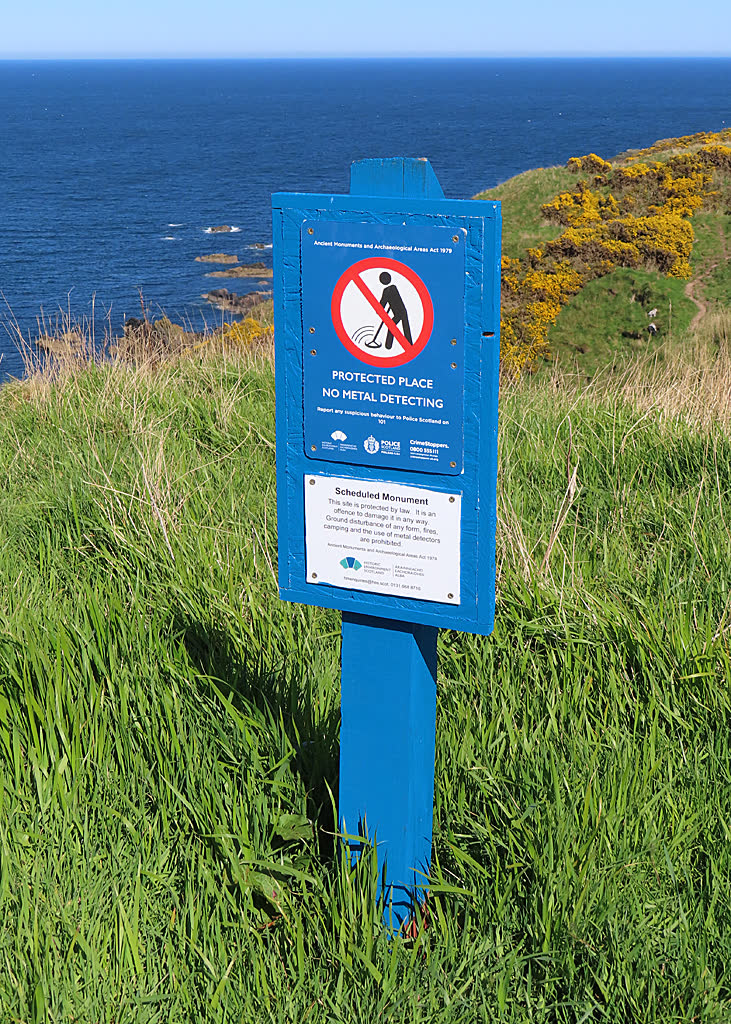
The safest formula. An old map, a missing sign, the owner saying yes, or one register returning nothing — none of these is on its own a permission to keep searching or to disturb the ground.
Four checks before you go
Before any outing, split the question into four separate ones. If even one of them has no clear answer, do not turn the doubt into a field experiment.
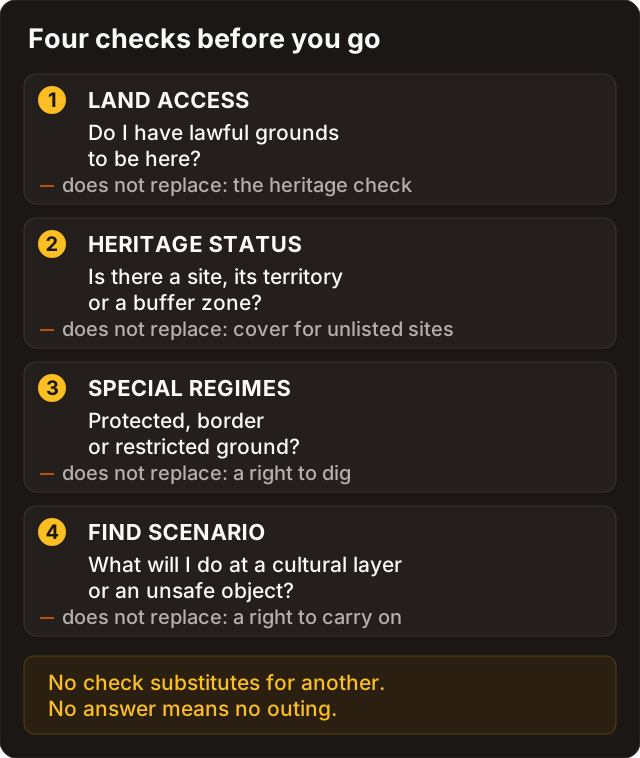
| Check | What to establish | Why one answer is not enough |
|---|---|---|
| 1. Right of access | On what basis you are on the land; whether you need consent from the owner, tenant, administration or another authorised party | Access to land does not switch off heritage, environmental, border or restricted-area legislation |
| 2. Heritage | Whether the available sources show a cultural or archaeological heritage site, its territory or its protection zone; what the regional authority says when you are unsure | A register is an important start, but one empty result guarantees neither the absence of restrictions nor the absence of an unrecorded site |
| 3. Special regime | Whether the place and the intended actions fall under nature-protection, border, military, restricted or municipal rules | Even with no heritage site present, not every action becomes automatically permissible |
| 4. Find scenario | What you will do if you see a cultural layer, a burial, a structure, a dangerous object or an object with the marks of an archaeological artefact | You need to know what happens after a discovery before you go out, not after the first irreversible action |
The table does not create risk-free zones. It exists so that you stop before one signal or one attractive historical hypothesis turns into an action with consequences. How to take a hypothesis all the way to a document without going into the field at all is shown in the worked case in archives in Russia and Belarus.
Off limits almost everywhere
The list is short and surprisingly consistent across jurisdictions:
- Cultural heritage sites and known archaeological monuments.
- Burial grounds, nature reserves, national parks and other protected areas.
- Private land without the owner's consent.
- Restricted and military zones.
A beach or a farm field does not mean "always allowed": the status of the land, protection zones and local rules decide. How this works in the UK, Poland, Germany and France is in metal detecting and the law in Europe.
Russia: heritage protection and the open sheet permit
Federal Law No. 73-FZ governs the preservation, use, promotion and state protection of cultural heritage objects, archaeological heritage included. The Russian Ministry of Culture maintains and publishes information on the permits it issues — the open sheets for work identifying and studying archaeological heritage; the official page states plainly that such work includes work whose purpose is the search for and removal of archaeological items.
| Question | What the official sources establish | The safe move for you |
|---|---|---|
| Who carries out work aimed at searching for and removing archaeological items? | The official open sheet system covers work identifying and studying archaeological heritage, including the search for and removal of archaeological items | Do not present an amateur outing as archaeological research, and do not start searching for archaeological items without a legal basis |
| How do you check a registered heritage site? | The Ministry of Culture names EGROKN, the unified state register, as the principal source on cultural heritage objects, their territories and protection zones | Check EGROKN and the records of the regional heritage authority; where anything is unclear, request a ruling for that specific area |
| Is there liability for unlawful searching and removal? | The Russian Criminal Code contains article 243.2 on unlawful search for and removal of archaeological items | Do not probe the limits by concealing your purpose or the circumstances; where risk appears, stop and get a legal assessment |
| Can a historical map authorise fieldwork? | No: a map is a source of historical hypothesis and does not replace a check of the legal regime | Use the map for an archive question, not as a route to interference on the ground |
The register is where the check starts, not where it ends
EGROKN records cultural heritage objects, their territories and their protection zones, and the Ministry also publishes an open EGROKN dataset. In practice this means two things.
- A positive result is a signal to stop and clarify the regime with the authorised regional body. The conclusion that a distant site leaves the ground beside it free is wrong without knowing its territory and protection zone.
- A negative result does not change the status of the place. The parcel may still need checking against other sources and regimes, and a register lookup answers neither the access question nor the question of what you intend to do there.
What this article does not promise
It does not claim that buying or owning a detector by itself creates or removes liability. It gives no permissible depth, no permissible age of object, no list of quiet fields. Those simplifications ignore the real combination of circumstances: place, purpose, object, cultural layer, heritage status, right of access and other regimes. Where the line runs between agreed archaeological research and an amateur hole is covered in test pits and their limits.
Belarus: a permit regime and chance discovery
Protection of archaeological heritage is governed by chapter 17 of the Code of the Republic of Belarus on Culture. An official explanatory note issued by a regional authority with reference to the Code — the Vitebsk city executive committee material — defines archaeological sites and artefacts and separately sets out the permit regime, the use of technical equipment and the procedure for a chance discovery.
| Question | The official position | The safe move for you |
|---|---|---|
| How may archaeological sites and artefacts be searched for? | Only during archaeological research carried out under a permit from the National Academy of Sciences of Belarus | Do not use a detector for the purpose of finding archaeological sites or artefacts outside that permit regime |
| May a metal detector be used for such a search? | The note states that using metal detectors, ground-penetrating radar and other technical means to search for archaeological sites or artefacts is prohibited, except for the permit holder and the participants in the research | If your purpose or the likely object of the search may relate to archaeological heritage, do not act alone; take the lawful research or educational route |
| What happens to an archaeological artefact found by chance? | Such artefacts are to be transferred into state ownership | Preserve the object and its context, stop anything that disturbs it, and follow the established notification procedure |
| What notification deadline does the note give? | The local executive and administrative body at base level must be notified in writing within no more than two calendar days; for a movable valuable the note sets out a temporary custody procedure | Do not delay, do not clean, do not sell, do not publish the exact location; keep proof that you filed the notice |
Important. Do not carry over to Belarus any model in which amateur searching is treated as acceptable provided the find is registered afterwards. The official note describes a different and stricter permit regime for the search for archaeological sites and artefacts.
Dealing in archaeological artefacts
The official note states that archaeological artefacts, whether found during archaeological research or by chance, pass into state ownership, and that their purchase, sale, gift, exchange and pledge are restricted by law with the exceptions the note names. For an Academy reader the rule that follows is simple: an object that may turn out to be an archaeological artefact is not turned into merchandise, into a swap item, or into a public display case.
The two regimes side by side
| Topic | Russia | Belarus |
|---|---|---|
| Archaeological research | The open sheet covers work identifying and studying archaeological heritage, including the search for and removal of archaeological items | The National Academy of Sciences of Belarus issues the research permit; the search for archaeological sites and artefacts is tied to that regime |
| Detector search for archaeological objects | The absence of a general licence for the device does not create a right to search for archaeological items: heritage protection and the open sheet regime apply | The prohibition on using metal detectors and other technical means to search for archaeological sites and artefacts outside permitted research is officially explained |
| Checking registered heritage | EGROKN plus the regional heritage authority | The Code on Culture, records held by the Academy of Sciences, and the local executive body or culture authority depending on the situation |
| A chance find | Stop at any sign of heritage or danger and establish the regional procedure; do not decide questions of ownership yourself | Preserve the object, stop disturbing actions, notify the local body in writing within two calendar days, follow the temporary custody procedure |
| Publishing the spot | Do not publish a sensitive location: it settles no legal question and can damage the site | Do not publish a sensitive location; discharge the preservation and notification duty first |
Land access does not cancel public restrictions
Consent from an owner, tenant or other authorised person can matter a great deal for getting onto private land. It does not, however, switch off the regime of a cultural heritage site, a protection zone, or environmental and other public restrictions. In the same way, the absence of a fence, a sign or visible ruins proves nothing about the absence of a protected context.
| Faulty reasoning | Why it does not hold |
|---|---|
| The land is private, so anything goes | Rights in land exist alongside public-law restrictions |
| The owner said yes, so archaeology is fair game | Private consent replaces neither an open sheet nor a permit, and does not lift heritage protection |
| I looked in the register and found nothing | One lookup is not a legal opinion and does not rule out other restrictions |
| I did not know it was a monument | Not knowing is not a safety strategy; at any sign of risk the right move is to stop and check |
| I am not going to sell anything anyway | The survival of a cultural layer and the lawfulness of a search do not turn on your intention to sell |
Stop signals on the ground
A stop signal does not require you to date an object on the spot. It is enough to see a feature that sharply raises the cost of a mistake.
| What you notice | Why you stop | The safe move |
|---|---|---|
| A barrow, grave, cemetery, evident burial or complex | Risk of breaching heritage protection, ethical norms and other rules | Do not dig, do not move anything, do not publish the exact spot; report through the local procedure |
| A cultural layer, structural remains, masonry, a dense scatter of fragments | The object matters together with the place and the layers | Stop the disturbance, record what is visible without widening the work, request a competent assessment |
| Unknown ordnance, a shell, a fuse, a military object | There may be immediate danger to life | Do not touch it, do not carry it, move away and call the emergency or competent services |
| Waterlogged organics, glass, a fragile composite object | Risk of irreversible loss through drying and cleaning | Do not clean, do not dry it fast, do not separate the parts; record it and choose a conservation route |
| An object with an inscription, a maker mark, a coating or a layered surface | The surface may be the main source of information | Photograph before any intervention, pack it separately, stop all active cleaning |
| Signs of an archaeological artefact in Belarus | A specific procedure for preservation, notification and transfer applies | Stop disturbing actions immediately and follow the official procedure |
In the field there is one rule. A map grants no permission and a signal confers no status. At any sign of a cultural layer, a burial or ordnance, the work stops where you stand: do not dig, do not move it, do not publish the spot — act through the local procedure.
A stop signal does not cancel the outing, it changes the mode: from recovery to recording. What careful recording looks like is set out in from signal to find; what to do with the object over the next day is in the first 24 hours.
What to do when you find something
Most finds require no procedure at all: a button, a bottle cap, a coin lost last century. But occasionally something comes out of the ground that is clearly older and more complicated — and then the first minute decides everything.
That minute is not the time to improvise. Below is the sequence that protects both the find and you. The sequence is the same in any country; how Russia and Belarus differ is in the table at the end of this section.
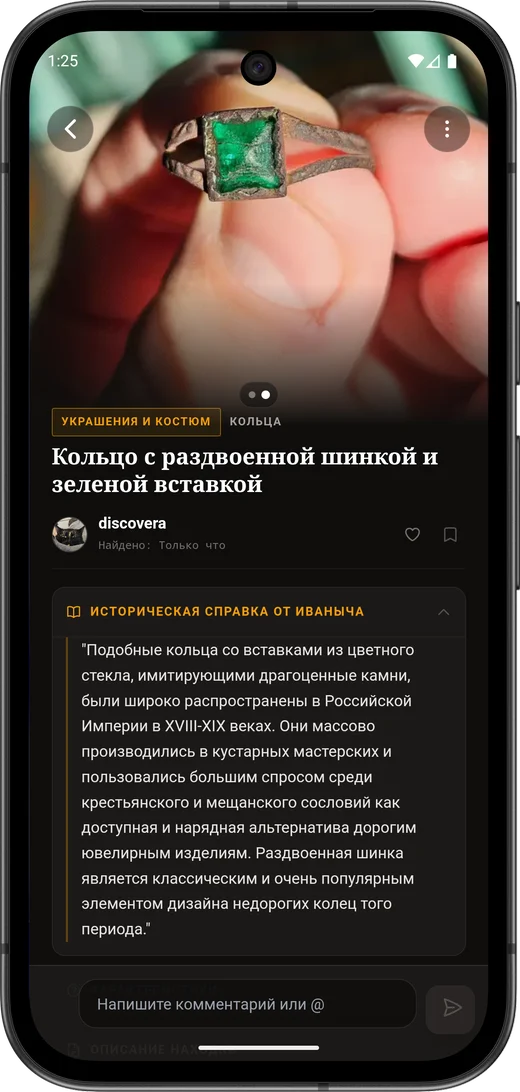
1. Stop
Literally: hands off. Don't wrench the object out, and certainly don't clean it where you stand.
Read the situation. Does this look like a complex — several related objects together? Are there signs of a burial? Are you on a heritage site you didn't spot on the map?
2. Record the place
While you haven't disturbed anything, the spot still carries information. Five minutes of digging and it won't.
- Coordinates and a pin.
- Landmarks on the ground: a tree, a boundary, the corner of a foundation.
- Depth and orientation — flat, vertical, in a cluster.
- Which historical map layer was open, if any.
3. Shoot it in situ
A wide shot so the surroundings are visible. A close-up before removal, if removal is legal and safe at all. A scale — a ruler, or any object of known size, in frame.
These photographs are the only thing that later separates "I found it in a field" from a documented find with context. And yes: exact coordinates of valuable complexes don't get published.
4. Notify, where required
If there are signs of a protected site, or a duty to report, contact your local heritage body or museum under the rules of your jurisdiction.
- UK: recording through PAS plus the separate Treasure rules.
- Poland, Germany, France: see metal detecting and the law in Europe.
- Russia and Belarus: the procedure is in the table below.
5. Ordnance: walk away
Shells, mines, grenades: move away, mark it, call the services. Don't touch it, don't lift it, don't take it home. More in safety.
6. Document
In the find card: photos, the map layer, a note of what you reported and to whom. The app is an archive of your actions, not a permission to remove anything, and that distinction matters.
Leave the cleaning for later — at home, calmly, following the guide for that metal.
If you're asked to wait
Sometimes the heritage body will ask you to leave the find in place or wait for an inspection. Follow the instruction.
At that point the diary works as a log: times, photographs, who you contacted, what they said. It is not proof of ownership — it is proof that you acted in good faith, and in a contested situation that turns out to matter more.
Russia and Belarus: a chance find step by step
A chance find is a moment for preserving information, not for attribution on the spot. Do not talk yourself into calling the object modern simply to avoid changing your plans.
| Step | Russia | Belarus |
|---|---|---|
| 1. Stop the disturbance | Do not widen the work at any sign of heritage, complex context or danger | The note requires you to suspend without delay any action capable of affecting the object |
| 2. Preserve what is visible | Photograph the general view and the object without cleaning or dismantling; do not publish the exact spot | Take steps to preserve it; do not clean it and do not part with it |
| 3. Notify | Obtain the procedure from the regional heritage authority or another competent body as the situation requires | Notify the local executive and administrative body at base level in writing within no more than two calendar days |
| 4. Do not dispose of the object | Do not sell, do not swap, do not misrepresent the circumstances of the find; in a dispute, a lawyer or the authority | Follow the official temporary custody procedure and the steps that follow it |
| 5. Keep a log | Date, location kept private, photographs, what you did and what you deliberately did not do, contact details of the notification | The same entries plus a copy of the notice and a record of the transfer |
The ethical side is in the safety and ethics guide.
Where to turn in your region
| Country | The first official route | What to write or ask |
|---|---|---|
| Russia | The regional authority for the protection of cultural heritage; for registered heritage, EGROKN as a preliminary source; for archaeological work, the Ministry of Culture material on open sheets | I request clarification of whether a cultural heritage object, its territory or its protection zone exists at the following address or cadastral reference; no work is being carried out pending your reply |
| Belarus | The local executive and administrative body at base level; the regional culture authority; on questions of archaeological research, the National Academy of Sciences and the Institute of History under the official procedure | I request that you accept a report of a possible material cultural valuable and clarify the procedure; place, date and visible condition are given below; all activity has stopped |
Keep the message short and factual. Do not attempt the specialist's attribution in it. Attach a general view photograph, give the district or a landmark, and keep a copy of what you sent. Do not publish the exact location in open comments or on social media.
What the app is for
Maps and a diary help you keep the context and record properly where that's appropriate and lawful. The app is not a permit, does not issue one, and does not get around heritage legislation — and no app does.
Field checklist
A short list for a note on your phone. It does not replace the sections above — it verifies that you have been through them.
Before you go:
- [ ] I have a basis for being on this land, and it would be clear to someone other than me.
- [ ] The heritage regime is checked against an official source, and any doubt is closed by an answer from the authorised body.
- [ ] Special regimes — nature protection, border, restricted, municipal — are clarified for this particular place.
- [ ] I can say out loud what I will do at a cultural layer, a burial, an artefact and a piece of ordnance.
- [ ] The detector is not being used to search for archaeological sites or artefacts.
After a find:
- [ ] The disturbance has stopped, the hole is not being widened, neighbouring signals are not being worked.
- [ ] Photographs of the general view and of the object were taken before any cleaning.
- [ ] The object has not been cleaned, dismantled, dried on a radiator or handed to anyone.
- [ ] The notification has gone out through the local procedure and a copy is kept.
- [ ] The exact location has not been published.
One line goes into the find record: date → private coordinates → original photo → what you noticed → what you did NOT do → who you told → reference number → next step.
FAQ
Where is digging almost always off-limits?
Monuments, burials, reserves, other people's land without consent, restricted sites. More in "Off limits almost everywhere" above.
Russia — what matters?
The cultural-layer provisions and article 243.2, from the official texts only and with a lawyer where needed. Beach and field are not synonyms for "always allowed".
UK — what’s different?
Through the landowner's consent and a culture of voluntary recording via PAS. The Treasure Act is a separate, mandatory reporting route that does not overlap with PAS. Detail in metal detecting and the law in Europe.
Poland / Germany / France?
A permit is often required, and archaeological searching without one is explicitly prohibited. Detail in metal detecting and the law in Europe. Other people's field videos are not a guide.
Found something contested — next read?
The "What to do when you find something" section above, then your local heritage body. The ethical side is in the safety guide.
Does an app replace a permit?
No. It documents and it teaches. The permit and the land status are a separate matter, to be settled before you leave.
What do I do with an unexpected old find?
Don't clean it, don't sell it, don't publish the exact location and don't alter the circumstances of the find. Record what is visible, stop anything that acts on it, and follow the rules of your country and region. In Belarus the official material describes written notification of the local authority within two calendar days and a procedure for temporarily handing over a movable valuable. How to record all this is in the find context card.
I own a metal detector, so may I search anywhere as long as I keep off the monument?
No. The question does not reduce to physical damage to a visible monument. What matters is the purpose, the place, the archaeological context, the regime of the land, the right of access and the nature of your actions. In Belarus the official note separately establishes a permit regime for searching for archaeological sites and artefacts with technical equipment. In Russia, work aimed at the search for and removal of archaeological items falls within the open sheet system.
An old map shows a village. Is that a basis for going there with a detector?
No. A historical map is a source for an archive question, not a permission. The site of a former village may coincide with an archaeological heritage object, with another protected area, or with a parcel whose regime is not obvious without a formal enquiry.
Is the field owner's consent enough on its own?
No. Consent concerns getting onto the land; it does not lift public restrictions attached to heritage, nature, the status of the territory or the procedure for archaeological research. These are two separate questions, and the second one is not the owner's to answer.
I checked the register and found nothing. What does that mean?
It means the first preliminary source returned no result. A register is not a legal opinion and does not replace a regional check: a site may be unrecorded, and restrictions may flow from other regimes entirely. Where archaeological indications or doubt exist, stop and clarify the status.
The object looks ordinary, but there is pottery, bone and masonry beside it. What now?
Treat the situation as a complex context: do not widen the intervention, do not mix objects together, do not clean them and do not publish the exact spot. Keep your original observations and photographs and approach the competent body.
Can I sell a find if it is old?
That is not a conclusion to reach on your own. For Belarus the official note points to state ownership of archaeological artefacts discovered by chance and to restrictions on dealing in them. In Russia the status of the object, its archaeological origin and the right to dispose of it all require a specific legal assessment.
What to read next
- Metal detecting and the law in Europe — the UK, Poland, Germany and France.
- Test pit: the line between research and amateur practice — why authorised archaeological work is not the same as a deeper hole.
- From signal to context — what you already know about an object before the spade touches the ground.
- The find context card — how to keep the photo, the place, the notification and the object's condition.
- The first 24 hours after a find — what to do with the object itself before any cleaning.
Sources
- Russian Ministry of Culture — information on issued permits (open sheets)
- Russian Ministry of Culture — EGROKN, the unified state heritage register
- Ministry of Culture open data — the EGROKN dataset
- Russian legal portal — Federal Law No. 73-FZ of 25 June 2002
- Russian legal portal — Criminal Code of the Russian Federation
- National Legal Internet Portal of Belarus — Code on Culture
- Vitebsk city executive committee — protection of archaeological heritage