
 Google Play
The most important restoration decision is usually made before the object ever reaches a table. In the first hours it is easy to lose a coating, traces of organics, a friable corrosion surface, the soil still attached, an inscription, or the link to the place. No amount of “careful cleaning” later restores what was washed off, polished away or detached on the drive home.
This is step zero of the restoration route: it sits ahead of the restoration principles and ahead of any talk of baths, solutions and brushes. Careful recovery and the first record made on the spot are covered in from signal to find; what follows here is what happens next — in a pocket, in the car and on the table during the first day.
The first job is not to improve the appearance but to preserve the as-found condition and the information.
This article does not replace the rules for handling cultural heritage, dangerous objects or human remains. If the place, the object or the context calls for a stop, no treatment is started.
A map and a detector grant no permission. Where there are signs of an archaeological layer, a burial, human remains or ordnance, work stops and the local procedure applies. Suspected ordnance or any other explosive object is not touched, not moved and not identified by yourself. The legal frame — set out for readers who search in Russia and Belarus — is in metal detecting and the law and in what to do when you find something.
Why the first hours matter more than the first cleaning
Once it is out of the ground the object moves from the environment it had settled into to a new one: humidity, oxygen, temperature, pressure, light and contact with hands all change. For some objects that is trivial; for others it is the start of accelerated decay.
Archaeological material is rarely one stable substance. More often it is metal, soil, salts, coatings, textile, wood, leather, glass and corrosion layers all at once. The Canadian Conservation Institute stresses that an archaeological object and the records about it form a single archive: what is decided in the field governs everything that follows.
| What a rush can cost you | How it usually happens | Why it is irreversible |
|---|---|---|
| The surface, the patina, a coating | Abrasive cleaning, polishing, acids, hard rubbing | The outer layer carries traces of technology, use, decoration and time |
| The context | Mixing objects together, losing the record, publishing a spot without a note | Later you cannot confidently tie the object back to the place and the circumstances |
| Fragile parts | Shaking off soil, breaking up a corrosion lump, a drop, packing everything loose | A detached fragment may be part of a construction or of a coating |
| Moisture-dependent structure | Uncontrolled drying of wet organics or of a composite | Shrinkage, cracking and delamination begin before any considered decision |
| The as-found appearance | Washing, “testing the metal”, reagents, oil | A photo taken after cleaning no longer shows what exactly was changed |
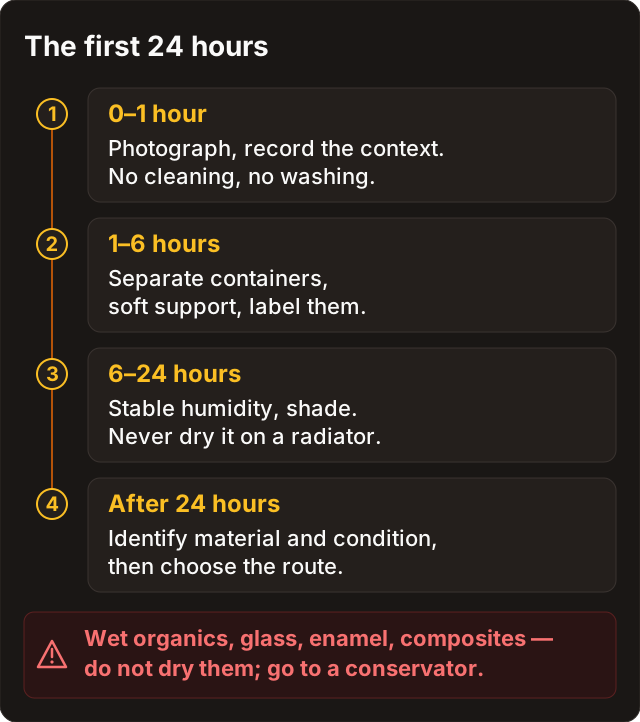
Four rules for the first day
These four sentences repeat throughout the restoration section. Remember only them and most of the routine losses will not happen.
- An unidentified material is not a candidate for chemical treatment. Colour and weight do not prove composition. Until the material is known, there is nothing on which to choose a reagent.
- Water is not a neutral, universal agent. The outcome depends on salts, porosity, the mix of materials and the condition of the object — water, salts and hydrolysis works through that in detail.
- Desalination is not “soaking”. It is a controlled conservation treatment with a diagnosis, a bath regime and a way of checking the result — not a jar of water on the windowsill.
- If an intervention cannot be justified and documented, it is not started. “Let us try and see” is not a justification, because the result is irreversible.
The rules bite precisely in the first day, when the object is already out of the ground but has not yet been examined calmly or described.
The universal route: record, isolate, assess
This route is not a restoration recipe. It exists for one purpose: to postpone irreversible decisions until there is a diagnosis.
| Stage | What to do | What not to do |
|---|---|---|
| 1. Stop | Check for signs of danger, a complex context or a protected site | Do not widen the intervention to get “the full picture” |
| 2. Record | Photograph the spot and the object as found; note the date, time, map source and observations | Do not reposition the object for a better shot and do not clean it before the photo |
| 3. Separate | Do not put wet, fragile, rusted and differently made objects together; tie each one to a record | Do not mix objects from different spots into one bag or box |
| 4. Describe, do not guess | Write down what you see: “green powdery surface”, “layered glass”, “damp fibrous fragment” | Do not record a contested attribution as fact: “bronze coin”, “leather”, “gold” |
| 5. Choose the next route | Temporary labelling and further diagnosis — or a stop and a consultation | Do not move on to water, solvents, electrolysis or mechanical cleaning “just to try” |
The formula for a good first record: “what I see” + “where and when” + “what I did not do and why”. It is worth more than an early conclusion about material or age.
From here the route splits. If the object is stable and the material is clear, the ordinary restoration checklist applies. If not, the next section explains exactly where to stop.
Stop signals: when a conservator or an authority is needed
A stop signal does not mean the object is necessarily rare. It means the cost of a mistake is high, and an amateur action can destroy data or create danger.
| Sign | Why stop | The correct action |
|---|---|---|
| Suspected ordnance, a shell, a fuze, an unfamiliar military object | Danger is possible regardless of appearance and age | Do not touch, do not move it, step away and contact the relevant services |
| Signs of a burial, human remains, an associated assemblage | Specific legal, ethical and scientific procedures exist | Stop, preserve what you observed and follow the local procedure |
| Wet wood, leather, textile, paper, bone or other organics | An abrupt humidity change and handling destroy the structure | Do not dry it “on a radiator”, do not clean it, do not bend it; consult a specialist as soon as possible |
| Iridescent, layered, matt or flaking glass | The surface layers are chemically altered and mechanically very weak | Do not rub it, do not wash it clear, do not separate layers; minimise handling |
| Metal with organics, enamel, stone, glass, gilding or plating | A method that is safe for the metal destroys the layer next to it | No reagents, no electrolysis, no hard cleaning; diagnosis first — see special cases |
| A mark, an inscription, traces of paint or lacquer, a thin coating | The surface layer may be the main source of information | Photograph, label, pause until it is assessed |
| Bright powdery or friable corrosion, cracks, delamination | An active process is possible; the strength of the object does not match its look | Isolate it from other objects, document it and choose the consultation route |
Water, air and abrupt changes
Water has no universal status as a safe agent. For one dense, stable object, removing surface soil is acceptable — but only after a diagnosis. For another, water carries salts, soaks the pores, alters the surface or starts rapid decay.
| Material or situation | Why no universal advice is possible | The safe first position |
|---|---|---|
| An unidentified object | Colour does not prove the material, the alloy or a coating | Do not wash it and do not use reagents until the route is decided |
| Metal with dense corrosion and salts | Vulnerable layers, organics or soluble salts may sit under the crust | Photograph, isolate, assess the condition; do not promise yourself home desalination |
| Wet organics | Drying causes shrinkage, distortion and cracking | Prevent uncontrolled rapid drying; get professional advice urgently |
| Archaeological glass | Water processes alter the surface layers and weaken the object | Do not rub it, do not wash it, do not remove iridescent or matt layers |
| A composite object | Metal, glass, bone, enamel and organics react to moisture differently | Treat it as a special case, not as “metal with dirt on it” |
For salt-contaminated metals the Canadian Conservation Institute specifically warns that objects under a corrosion crust or with salt contamination should not simply be left to dry before conservation treatment. That is not a home-treatment instruction; it is a reason to stop and not substitute soaking for diagnosis.
Glass carries a different risk. Historic Jamestowne describes how water processes lead to leaching of the surface layers and dissolution of the glass network: such an object can fail during ordinary handling. The mechanics behind all of this — salt crystallisation, metal corrosion, hydrolysis of organics — are covered in water, salts and hydrolysis.
A condition card before any intervention
The card is not bureaucracy. It lets you tell a later change from the as-found condition, and show the object to a conservator without extra guesswork.
| Field | What to record |
|---|---|
| Identifier | A unique number unconnected to any public spot |
| Date and time | When the object was spotted, recovered and taken into storage |
| Place | A private reference, a general landmark and the map layer; sensitive coordinates are not published |
| Photo before intervention | General view, obverse and reverse, a scale and raking light where possible |
| Observed material | “Yellow metal?”, “green deposit”, “glass?”, “organic fragment?” — with a question mark whenever unsure |
| Condition | Cracks, friability, moisture, salts, layering, smell, loose parts, a mark or inscription |
| What was done | Facts only: “photographed”, “stored separately”, “nothing was washed” |
| Next observation | “Re-examine after…”, “show to a conservator”, “check against the Academy article” |
How to keep such a card over time, without losing the context a year later, is covered in the find record.
Temporary packing and separate storage
At this stage it matters less to pick the perfect packing material than to avoid creating a new problem. Fragile things are not carried loose, wet is not mixed with dry, anything active does not touch other objects, and labelling does not depend on memory.
| Principle | What it means in practice |
|---|---|
| One object, one record | Separate labelling that keeps the link to the photo and the place |
| Different materials, not one pile | Do not put glass, corroded metal, organics and ceramics in a shared container |
| Less mechanical action | Do not shake it, do not “knock the soil off”, do not wrap the object in adhesive tape |
| More stable, not more extreme | No drying near a heater, no leaving it in the sun, no aggressive household liquids |
| A legible log | Not “it is around somewhere” but “ID…, photo…, condition…, checked on…” |
Storage and conservation are different stages. The Society for Historical Archaeology recommends treating the storage environment, the packing and the monitoring as part of the long-term survival of a collection. In the first day the goal is more modest: do not make the condition worse before the correct regime has been chosen. What comes after, and how to notice renewed decay, is in after conservation.
What not to do “as a test”
| Action | Why it is not a diagnosis |
|---|---|
| Polish it bright to “identify the metal” | Shine does not establish composition, and the surface can be lost for good |
| Put a drop of acid or a reagent on it | The reaction damages coatings, patina, enamel, glass and composite objects |
| Soak it “to get the salts out” | Desalination is a controlled procedure; an unidentified material is not treated on one symptom |
| Run electrolysis “for a minute” | A method cannot be safely tested on an object of unknown structure, coating or significance |
| Pick the soil off with a knife or a needle | That lump may be the only thing holding fragile layers or organics together |
| Wipe it with oil, wax or lacquer | A coating masks the surface and complicates later assessment and conservation |
The Society for Historical Archaeology treats conservation as a procedure with diagnosis, regime and documentation, not as a set of household tricks. The order of work and the risks of reagents are in corrosion chemistry, together with PPE, ventilation and disposal of solutions. The first day is no place for an experiment: every reagent has a cost of error, and protection and extraction are rarely available in a car or a kitchen.
The first 24 hours in Discovera
Use the app as a decision diary, not as a showcase of “after cleaning”. The find card should keep the original frame, the original description and the reason you stopped.
| Feature | Safe use |
|---|---|
| Photos | Upload the as-found frames first, not only the result of treatment |
| Historical layer | Keep it as the source of a hypothesis about the place, not as proof of legal status |
| Private marker | Keep the context without publishing sensitive coordinates |
| Note | Record what was done and, more importantly, what was deliberately not done |
| AI hint | Use it as a suggestion from a photo; it does not replace an assessment of danger, material or condition |
What to read next
- From signal to find — careful recovery, context and the first record on the spot.
- Restoration principles for finds — minimum intervention, reversibility and the decision not to clean.
- Restoration checklist — the order of work once the material is known.
- Water, salts and hydrolysis — why there is no universal rinse.
- Special cases — composites, coatings, glass, enamel and organics on metal.
- After conservation — the observation log and the signs of renewed decay.
- Preservation and storage — microclimate, barrier and long-term storage.
FAQ
Should the soil be cleaned off straight away?
No. Soil is not always dirt to be removed at once: a lump of earth often holds fragile layers, organics and small details in place. Until the material and the condition are known it is safer to record the object, isolate it, and only then choose the route.
Can I at least rinse it with water?
Do not grant yourself a universal permission. Water behaves differently on different objects: with salts, wet organics, glass, composites and unidentified materials a thoughtless rinse makes the condition worse and can start a process a conservator then has to stop.
I have already cleaned it. What now?
Do not compensate with another active intervention. Photograph the current state, write down honestly what was used and how much, then move to the article for that material or to a specialist. An honest note saying “rinsed under the tap, scrubbed with a brush” is more useful than silence.
If the object looks ordinary, is a card still needed?
Yes. A short card takes minutes but keeps the link between the object, the place, the date and the condition. That matters especially if corrosion appears a few weeks later, or new information about the place turns up.
How long do the “first 24 hours” actually last?
It is a frame, not a timer. It means the gap between recovery and the first considered decision about material and regime. If the object is wet, organic or clearly unstable, shorten that gap and reach a specialist sooner. If it is dry and stable, a calm pause costs nothing.
When should a conservator be involved?
Immediately for wet organics, glass with an unstable surface, composite materials, coatings, marks and inscriptions, active friable corrosion, a rare or significant object — and for any doubt about the material. A pause is almost always safer than an irreversible experiment.
Sources
- Canadian Conservation Institute — Caring for archaeological collections
- Canadian Conservation Institute — Care of metal objects
- Historic Jamestowne — Handle with Care: Glass
- Society for Historical Archaeology — Collections Storage and Curation
- Society for Historical Archaeology — Conservation Treatments