
 Google Play
There is a common assumption that cleaning ends when the object is clean. In fact, at that moment you have returned the metal to roughly the state it was in the day it entered the ground: exposed, reactive and ready to corrode all over again.
Preservation is not a final polish, it is the mandatory last step, and it does not end on the day the wax goes on either. For most materials the real result shows up later: whether the bloom came back, whether the colour shifted, whether the barrier is holding, how the object behaves in its new storage. So this article has two halves: first how to seal the surface, then how to keep watch, so that a year from now you can answer the question "is it stable, or has it just changed appearance for a while".
Before you start, make sure the cleaning is genuinely finished: copper and bronze, iron and cast iron. If the object has only just come out of the ground and cleaning has not happened yet, this is not where you begin — start with the first 24 hours after a find: a barrier over an undried, undocumented object is not preservation.
Successful conservation is not maximum cleanliness. It is a known condition, minimal risk of further deterioration, and a traceable history of decisions.
Rule zero: dryness
Everything else is secondary. Wax on a damp object seals the moisture in. You have just built a small airtight chamber in which corrosion will be extremely comfortable.
- After chemistry, rinse with distilled water, thoroughly.
- Dry with warm air. Porous iron needs days, not hours.
- Don't seal anything that is still damp or still shedding.
And separately: don't put freshly cleaned metal into a plastic bag undried. Condensation inside the bag will undo the whole job in a fortnight.
What to seal the surface with
One barrier does not suit every object
Wax, oil and an acrylic consolidant are different answers for different materials and different states, not three brands of the same thing. Dense bronze, porous iron, thin gilding or silver plating, enamel, glass, bone, leather and any composite object all behave differently under a barrier: what is a thin protective film on one is sealed-in moisture, or an irreversibly altered surface, on another.
Before you apply anything, answer three questions: what the object is made of, what exactly sits on its surface, and whether that layer can be removed later without harm. If even one answer is missing, no barrier goes on — the object goes into dry, stable storage and observation instead, and, if anything is actively changing, to the advice in special cases.
Wax or paraffin
| Product | Pros | Cons |
|---|---|---|
| Microcrystalline wax (e.g. Renaissance Wax) | Thin, controllable film; museum practice for small objects | Costs more, wants a light hand |
| Paraffin | Cheap, quick barrier for field finds | Easy to overdo and end up with a crust |
Either way: apply thinly and wipe the excess with a soft cloth. A thick layer does not protect better — it just stops you noticing that something is happening underneath it.
BTA for copper
Benzotriazole is used as an inhibitor for copper and its alloys, in hobby practice too. The usual approach is a solution in alcohol, a short soak, drying, then wax. Be more careful on silver, where the appearance can change.
What matters is what it is not: BTA does not cure active bronze disease and does not replace sesquicarbonate.
Oil for iron
Clean dry iron gets a thin film of neutral oil or a dedicated product, with the excess wiped off. For larger pieces oil is often more practical than wax — easier to apply evenly and easier to renew. Storage still has to be dry.
Paraloid B72
A museum acrylic consolidant, mixed with solvent to a recipe. At home it is only worth it if you understand what you are doing with concentration and ventilation: get it wrong and you have a cloudy film to remove.
For most everyday finds, wax or oil plus dry storage gets the same result with noticeably fewer ways to miss.
What not to do
Wax over active bronze disease or wet iron is not preservation, it is a way of temporarily not seeing the problem. Thick paraffin applied "forever", after which nobody inspects the piece, works the same way.
Storage *is* preservation
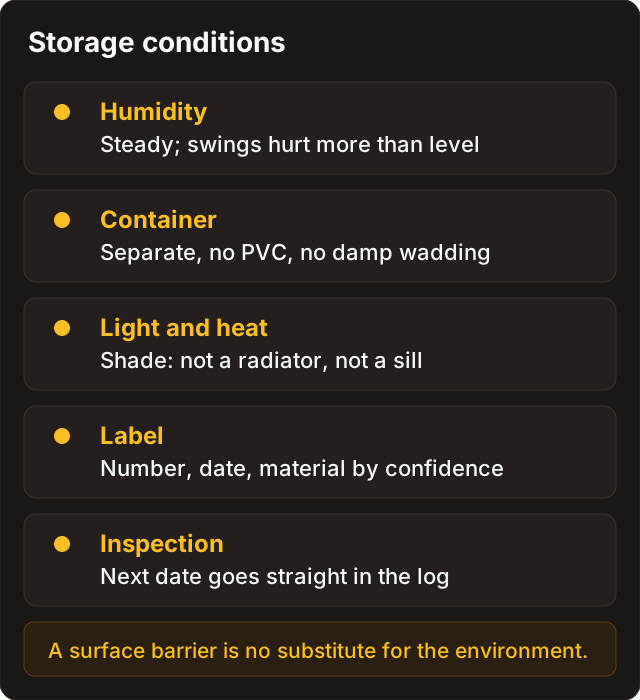
The layer of wax decides less than the conditions the object sits in for the other 364 days of the year. Those conditions have to be predictable: sharp swings in temperature and humidity, sunlight, unsuitable packaging, constant moving and dust will undo any careful treatment.
| Environmental risk | Why it matters | Safe principle |
|---|---|---|
| Sharp humidity swings | Affect salts, corrosion, organics, coatings and adhesives | Aim for stability, not for extreme dryness or damp chosen without understanding the material |
| Radiator, sun, car, windowsill | Fast local changes in temperature and light | Do not store historical objects where swings are unavoidable |
| Dense packaging of unknown make-up | Traps moisture and off-gassing, or presses on the object | Choose clean, inert where possible, supportive packaging; keep doubtful material out of long-term storage |
| Different materials in contact | Metal, glass, organics and coatings damage each other through friction and contamination; dissimilar metals in damp conditions add galvanic corrosion | Separate objects, do not store them loose in a heap |
| A hidden problem in the coating | Wax, oil, lacquer or adhesive change over time | Document every earlier coating; do not add layers without an assessment |
Silica gel in the box helps, but a popular article cannot prescribe one ideal humidity. The regime depends on the composition, the history of the object and the condition it is already in — which is exactly why the Canadian Conservation Institute treats archaeological collections separately. The one universal piece of advice: avoid fast swings, and do not change the regime radically without understanding the cause.
What a stable object actually means
Stability is not a perfect surface. A historical object keeps its stains, patina, corrosion layers, darkening, wear and traces of time. Those are not defects to be corrected — more often than not they are the object itself. Restoring finds: the basics says the same thing: reversibility and minimal intervention matter more than shine.
Stability means something else: the object shows no rapid unwanted change under suitable storage conditions, and its condition can be tracked.
| Poor criterion | More useful criterion |
|---|---|
| “The object is shiny now” | “The surface condition is described and is not getting worse between checks” |
| “No bloom visible today” | “The cause of the change has been assessed; no renewed activity under observation” |
| “The shape looks intact” | “Cracks, layers, coatings and weak areas are documented; no new losses” |
| “I used a strong method” | “The intervention was justified, minimal and recorded; the consequences are monitored” |
Preventive conservation is built around the storage environment, packaging, collection handling and regular observation, not around a one-off treatment: the Society for Historical Archaeology frames storage strategy exactly that way — object, room, packaging and monitoring in one package.
The inspection schedule
You do not need to inspect the object every hour. You need a schedule agreed in advance and adjusted to the material and the condition. For an unstable, salt-bearing, composite or recently active object a conservator sets the intervals; for everything else, calm periodic checks beat constant random handling.
| Checkpoint | What to compare | What to record |
|---|---|---|
| Immediately after a stage is finished | Surface, integrity, loose fragments, original marks | Photo, date, exactly what was done, materials and methods, storage conditions |
| First scheduled inspection (a few weeks later) | New bloom, colour change, powdering, cracks, smell, droplets and condensation | Either “no change” or a precise description and a photo of the same area |
| Seasonal check | Effect of heating, damp season, moves, light | Storage environment and how it differs from before |
| After a move, exhibition or transport | Mechanical damage, shifted fragments, state of the coating | Transport conditions and a control shot |
| On any warning sign | Where the change is and how fast it spreads | Active work stopped, isolation if needed, escalation decision |
Monitoring should be rare enough not to create a constant risk from handling itself, and regular enough that a change does not slip past. For very fragile objects even photography and moving need a plan of their own.
Control photos: comparable, not beautiful
The same angle, scale, light and background show what memory will not hold. An artistic shot is for publication, a control shot is for preservation. They are different photographs and should not be confused.
| Element of the shot | Why it is needed |
|---|---|
| The same angle every time | Lets you compare the edges of a bloom, cracks and corroded areas |
| Soft diffuse light | Gives an overall view without harsh glare |
| Raking light for relief | Shows delamination, unevenness, lifting edges of a coating |
| Scale and ID in frame | Keeps the size and the ownership of the shot from getting lost |
| Overall and detail shots | Shows both the whole object and the potentially active area |
| The original file | Keeps the data for a later assessment, not just a compressed picture for publication |

The Discovera restoration card keeps those shots next to the treatment date and the barrier used — a year later there is something to compare against.
Six signs of renewed activity
No single sign is a diagnosis on its own. But any one of them is enough to stop home treatment, save a photo and think about a consultation.
| Sign | What may be behind it | What to do first |
|---|---|---|
| New powdery or crystalline bloom | Renewed corrosion, salts, a change in the storage environment | Photo from the same angle, date, isolation from other objects if in doubt, consultation |
| A green, orange or whitish area spreading | Active corrosion or salts; the earlier diagnosis was imprecise | Do not clean it back to bare metal; compare with the control photo |
| New cracks, delamination, flaking | Mechanical instability, humidity change, internal stress | Reduce handling, support fragments without glue or improvised fixatives |
| Change in gloss or colour, a sticky film | An old coating, plasticiser migration, oxidation, a reaction to the environment | Do not add fresh lacquer or oil; record whatever is known about earlier treatment |
| Smell, condensation, traces of mould | Unfavourable humidity, contamination, a storage problem | Check the environment, do not mask it with fragrance; consult if organics are involved |
| Fragments separating, a joint opening | Adhesive failure, different shrinkage of materials, mechanical stress | Do not glue it back just in case; gather data on the material and earlier treatment |
A spreading powdery light-green spot on copper and bronze is the one sign in that table where waiting is itself destructive: the detail is in copper and bronze. Orange dust and blisters on iron usually mean drying was incomplete or salts stayed inside — see iron and cast iron and water, salts and hydrolysis.
If the changes come back: the first minutes
The sequence is the same for all six signs, and it is deliberately boring. A return of bloom, powdering or flaking is not a signal to repeat the previous method "harder", and not a reason to apply thicker wax.
- Stop any active work. No rubbing, no washing, no fresh layer.
- Take a control photo from the usual angle — the overall shot and the detail — and compare it with the previous one: is the change genuinely new, or was it always like that.
- Check storage: humidity, packing, dissimilar metals side by side, the state of the silica gel.
- Read the log: does the onset coincide with a new product, a repack, or the box being moved. Record the observation with a date — before the next attempt, not after.
- If in doubt, isolate the object from the rest of the collection: active salts and off-gassing are a shared problem, not a private one.
- If the change is growing between inspections, escalate — do not attempt a second clean.
A repeat clean removes the symptom. The cause stays and comes back, usually faster than the first time and on thinner metal.
A conservation log, not memory
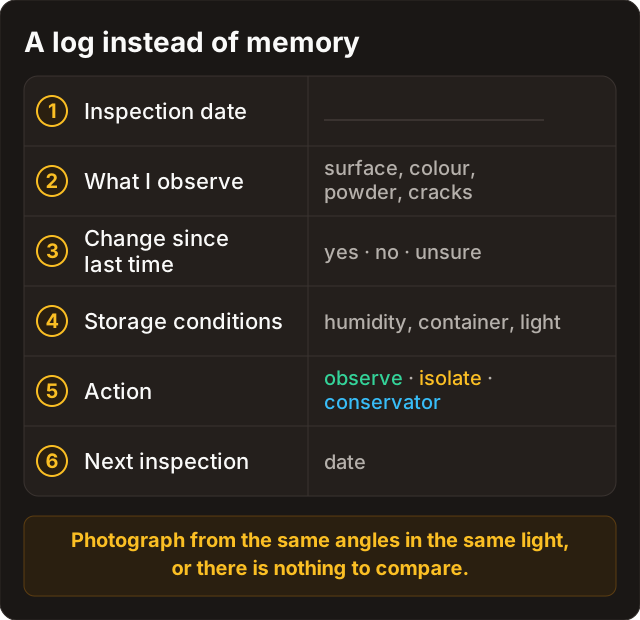
A year from now you will not remember which product is on that buckle, when it went on, or whether the box was ever moved. Memory is not a record; a conservation log is. One card per object, filled in as you go, is worth more than any extra coat of barrier. And it is needed even when no treatment happened: it shows that doing nothing was a decision rather than forgetfulness — exactly the record a conservator, a museum or a buyer will read later.
| Record block | What to include |
|---|---|
| Identity | ID, name and description, date acquired, a photograph taken before anything was done |
| Initial condition | Material with a confidence level ("copper/bronze?" beats false precision), visible risks, fragments, marks, coatings, context |
| Decision | What was chosen — observation only, consultation, agreed conservation — and why |
| Intervention | Date, who did it, the goal, and the materials and actions actually used |
| Storage conditions | Location, type of packaging, changes and moves |
| Monitoring | Inspection date, photo, observations, next due date |
| Escalation | Who received the object, consultation or report number, further restrictions |
The first lines of the log are written not after conservation but on the day of the find: what was done in the first 24 hours — drying, packaging, the decision not to wash — later explains half of what you observe. Context attaches to the same record: a find record with context keeps location, depth, soil and neighbouring objects in one entry alongside the condition photos.
Status in the card is best reduced to three. It reflects condition and decision, not the perceived value of the object.
| Status | What it means | What comes next |
|---|---|---|
| Observation | No change between inspections, environment stable | Scheduled check, nothing touched |
| Stabilisation by a specialist | Treatment agreed and carried out professionally | Follow the conservator's advice, keep the log |
| Needs urgent assessment | Activity growing, fragments separating, environment unknown | Isolate, record, escalate; home treatment stops |
Findspot, depth and neighbouring objects are part of the scientific value of the object. If it looks like part of a cultural layer, a burial or ordnance, the work ends at recording and notifying under the local procedure, not at cleaning. Neither good conservation nor a tidy log replaces permits.
When you need a specialist
| Situation | Why not to keep going on your own |
|---|---|
| Activity grows between inspections | Repeat treatment without a diagnosis will hide or worsen the problem |
| Flaking glass, wet organics, a coating or a composite | Different materials need a compatible strategy, not a universal one — see special cases |
| Inscriptions, maker's marks, traces of paint, gilding or enamel | Losing the surface means losing the key information |
| The object is fragile, deforming or falling apart | It needs support, diagnosis and professional stabilisation |
| The history of earlier treatment is unknown | New solvents and coatings may be incompatible with what is already on it |
| Publication, museum transfer or an exhibition is planned | Traceable documentation, handling rules and a conservator's assessment are required |
Going to a conservator is not an admission of defeat. It is the same decision not to clean, taken one level up.
In short
- Cleaning finished, spots stable; distilled rinse, then a full dry.
- Barrier chosen for the material and the state, not "the usual one", and applied thinly.
- Predictable storage: no swings, materials kept apart.
- Stability is a trackable condition, not shine; the inspection schedule is set in advance.
- Control photo: same angle, same light, scale and ID in frame.
- A warning sign means stop, photo, record, check the environment, isolate if in doubt.
- Keep the log always, including the decision to do nothing.
- Growing activity is a route to a specialist, not a second clean.
FAQ
The bloom is back on the object. Should I clean it again straight away?
No. First compare with the control photo, record the date and the storage conditions. A repeat clean removes the symptom but not the cause, and every cycle takes a little more metal with it. If the change is active or growing, take the consultation route.
Can I put a fresh layer of wax or lacquer on to seal the problem?
Not as a reaction to a change you do not understand. A new coating masks the signs, alters the surface and complicates any later conservation — including for the specialist the object eventually reaches. First work out what changed and what coatings are already there.
How often should I look at the object?
It depends on the material and the condition. A stable object needs no more than a calm scheduled check; for a recently active, salt-bearing or composite object a conservator sets the schedule. Excessive handling is a risk in itself: a share of collection damage happens during handling.
The object looks worse after storage. Does that mean the conservation failed?
That conclusion cannot be drawn from a single sign. Record the change and check the history: environment, packaging, moves, earlier coatings, material and initial condition. Deterioration is a reason for assessment, not for haste and not for embarrassment.
Should I keep every photo, even the bad ones?
Keep the original and control shots if they help trace the condition. Publication duplicates can be selected separately, but the observation archive has to stay continuous: one skipped year turns a series into two shots that cannot be compared.
What if the object came to me already treated and its history is unknown?
Assume there is a coating and that its composition is unknown. Start the log from today's date, take control shots, describe the visible condition, and put nothing on top. An unknown earlier treatment is itself grounds for a consultation, not for an experiment.
Sources
- Society for Historical Archaeology — Collections Storage and Curation
- Canadian Conservation Institute — Caring for archaeological collections
- Canadian Conservation Institute — Care of Metals
- National Park Service — Conserve O Gram technical leaflets on collections storage
- American Institute for Conservation — finding a conservator