
 Google Play
An old map is the start of an investigation, not the end of it. A sheet can show a vanished hamlet, a mill, a manor, a railway spur or a border. To learn what exactly stood at that point, when it existed and which sources survived, you need documents: plans, registers, correspondence, photographs, reports, inventories, reference books and finding aids.
An archive is not a search box. It keeps documents in the order of their origin: fond, inventory, file, folio. So a strong request does not begin with “find everything about this village” — it begins with a research question, a territory, a period and a type of source. The sharper the question, the better your chance of getting a usable lead, a reference code or a substantive official answer.
Below is the route from a hypothesis on a sheet to a letter, a code and a copy. The institutions here are Russian and Belarusian, and the procedure is written for readers who research in those two countries; the habits transfer elsewhere, the addresses do not. At the end comes a worked teaching case that walks the whole route: from an abbreviation for "mill" on a sheet to a conclusion no stronger than the document. How to get the hypothesis in the first place is in How to read an old map and Terrain on an old map; Soviet sheets are covered in Red Army and General Staff maps.
The core principle. First decide which document you are looking for; then who could have created it; and only then where to write.
The contacts in this article were checked on 19 August 2026. They are a working starting point, nothing more. Before you write, open the institution’s official page: addresses, submission procedures, forms, fees and opening hours change, and only what the archive publishes itself is binding.
Archive, museum or library: where your question belongs
One place can be tied to several institutions at once. A building plan is more likely to sit in an archive or a library; an excavated object in a museum collection; a photograph in a film-and-photo archive; a local-history book in a library. Writing to the wrong address is not fatal, but it costs weeks. So decide on the type of source first, not on the best-known institution.
| What you are looking for | Where to try first | What to ask for |
|---|---|---|
| Plan, sketch, land-survey document, official correspondence, register, report | State or departmental archive, chosen by territory and by who created the document | Whether the fond, inventory and file exist, the reference code, and whether copies can be ordered |
| Historical map, atlas, gazetteer, newspaper item, rare book | National or regional library: map department, manuscript department, local-history collection | The catalogue record, the shelf mark, a digital copy or the terms of work in the reading room |
| Photograph, newsreel, sound recording | Audiovisual archive, museum or regional archive | Whether the item exists, usage rights, a copy or preview, and a description of the shot |
| Object, collection, excavation results, accession history | State or municipal museum, museum reserve, specialist research museum | Whether the object or collection exists, the accession number, the record card, publications, terms of consultation |
| History of a works, a project, an engineering structure | Technical archive, company archive, regional archive, specialist museum | Design documentation, technical passport, drawing, report, dates of construction and rebuilding |
| History of a person or a family | Historical, regional or municipal archive; sometimes a departmental archive | Not “the whole family tree”, but one concrete fact: an entry, a period, a settlement, a denomination or institution if known |
Museums and archives solve different problems. An archive helps establish the documentary trail and the context. A museum works with objects and collections: it can point you to literature, a publication or storage conditions, but it is not obliged to run a broad historical investigation on request.
The field boundary. Neither an archival certificate, nor a map, nor an empty line in a register grants permission to dig — those are answers to different questions. If signs of a cultural layer, a burial or ordnance appear on site, stop work, lift nothing and follow the local procedure. What legal status actually decides, and what it does not, is in metal detecting and the law.
Five steps before the first letter
1. Reduce the question to one line
A bad question: “What was in this wood?”
A good question: “Do plans, registers or correspondence survive about the watermill near the village of N, within the former N district, for 1880–1917?”
One question does not limit the research. It makes the first request answerable and gives the archivist a search route they can actually follow. The second, third and tenth questions come later, off the back of the first answer.
If your trace is linear — a road, a causeway, a crossing, an embankment — phrase it the way the sheet reads it, not the way the ground looks today; the logic of linear features is covered in Terrain on an old map.
2. Build a place passport
| Field | What to record |
|---|---|
| Modern name | Settlement, district, region or province, country |
| Historical names | Every variant from the sheet, pre-reform spelling, the Polish, German or Belarusian form — without a hasty translation |
| Administrative attachment | Uyezd, guberniya, powiat, voivodeship, district, village council — for the period you actually need |
| Coordinates | Keep them private; they help align maps but grant no right of access |
| Period | A range of years, not “long ago” |
| Type of feature | Mill, manor, church, station, works, hamlet, road, cemetery, bridge and so on |
| Source of the hypothesis | Map series, sheet number, year, link to the scan, literature |
Keep name variants in the form printed on the sheet: it is the spelling, not the modern version, that surfaces a file in a finding aid. How a map labels its own features is unpacked in How to read an old map.
3. Work out who created the document
Ask yourself: who could have produced the paper you want? The administration produced correspondence and reports; an engineering department produced the design; a landowner or estate produced the inventory; a railway produced the diagram; a museum or expedition produced the research report. Choosing an archive by the creator of the document works far better than choosing it by the name you happen to know.
4. Find at least one reference code or catalogue
Look on the institution’s own site for a guide, a fond catalogue, an electronic catalogue, inventories, a database, a finding-aid section. For Russian federal archives there is an electronic catalogue of archive guides: its job is to help you identify the holding archive and the composition of its fonds, not to replace the request itself. In Belarus the Fond Catalogue of the state archives holds part of the information on the composition, content and location of more than 50,000 fonds.
Even one fond number moves your letter out of the “general enquiry” pile and into the “please check this specific thing” pile.
5. Check the rules of this particular institution
Before sending, confirm whether the archive accepts electronic enquiries, whether a form is required, whether copies are issued remotely, whether it handles subject requests, and what deadlines and paid services the site lists. RGIA, for example, publishes a separate form for copying requests and states that file-request slips are submitted after registering a personal account.
How to read an archival reference code
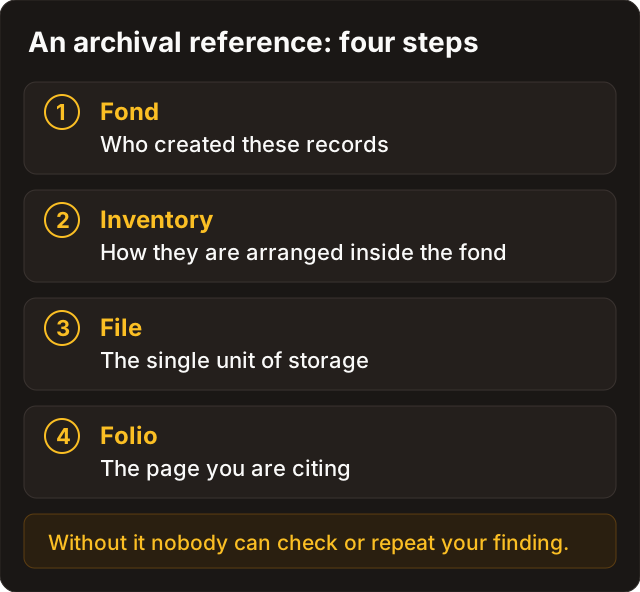
A reference code is the document’s address inside the storage system. The most common form looks like this: f. …, inv. …, file …, fol. … verso — fond, inventory, file, folio and the reverse of the folio.
| Part of the code | What it usually means | What to state in the request |
|---|---|---|
| Fond | Documents of one institution, family, organisation or individual, grouped by origin | The number and the exact name of the fond |
| Inventory | The list of files inside a fond, often by period or subject | The inventory number and its title, if it has one |
| File | A specific folder, volume, register, plan, bundle of correspondence or other grouping | The number and the title of the file |
| Folio | A page or frame inside the file | The folio number if known; say explicitly if you need the reverse |
| Storage unit | A broader term for a single accounted object | It does not replace the code, but it is useful in a description |
A reference code does for a document what a detailed description does for an object in identifying finds: without it the conversation is about “something similar”, with it the conversation is about one specific thing.
Never hide the fact that you found a code in a third-party publication or a user-built database. Say it plainly: “Please confirm whether code … belongs to your holdings and whether it is accessible.” The archivist can then correct an error in the citation without extra rounds of letters, and you do not lose a month on a file that is not in that archive at all.
What to ask for: documents, copies, a search or a consultation
One of the best ways to ruin a request is to mix several services into one letter. Decide first which outcome you need.
| Goal | How to phrase it | What not to ask |
|---|---|---|
| Check whether material exists | “Please advise whether documents on … for … survive; I am interested in plans, registers and correspondence” | “Send me everything you have” |
| Confirm a reference code | “Please confirm the existence and the full reference code of the document cited in …” | “Find every similar file across two centuries” |
| Order a copy | “Please advise the possibility, cost and procedure for ordering a digital copy: fond …, inventory …, file …, folios …” | “Scan the whole fond” |
| Request an extract or certificate | “Please verify one specific fact: …; if confirmed, please issue an archival extract or copy” | “Confirm the entire history of the family or the site” |
| Book a reading-room visit | “I plan to work independently; please advise the registration procedure and how to pre-order files” | “Draw me up a list of everything worth looking at” |
| Ask to be redirected | “If these documents are not in your holdings, please suggest the archive or type of fond where I should look” | “Forward my request to every archive” |
The honest boundary. An archive will help with a search inside its own competence, but it is not obliged to run an open-ended investigation. Precision is respect for the archivist’s work and it saves you money: a paid subject search on a vague question costs the same as one on a sharp question and returns markedly less.
Russia: a practical route
In Russia the search almost always starts from territory and time. Check the regional or municipal archive first if the question is tied to a specific settlement. Then add a federal or departmental archive once you know who created the document: a central body, a ministry, a military department, a railway, a state institution, a large organisation or a personal fond.
Entry points in Russia
| Institution or resource | Which tasks to start there | Contacts checked on 19 Aug 2026 |
|---|---|---|
| GARF — State Archive of the Russian Federation | National history, records of state bodies, social-legal and subject requests — after you have worked through the finding aids | 119435, Moscow, Bolshaya Pirogovskaya St 17; second building — 121059, Moscow, Berezhkovskaya Emb. 26. Official address for registering requests: [email protected]; for the Berezhkovskaya building — [email protected]; research information and reference department: +7 (495) 580-88-65. Contacts page |
| RGIA — Russian State Historical Archive | History of the Russian Empire, records of central institutions, departmental and personal papers, when the catalogue points to RGIA | Copying requests: [email protected]; reference information centre: [email protected], +7 (812) 438-55-54; progress enquiries: +7 (812) 438-55-57. File-request slips go through a personal account — official site |
| Catalogue of federal archive guides | Before writing: to work out where the fond you need might sit and how to frame the request | Electronic catalogue of guides to the fonds of the federal archives |
| Regional state archive or municipal archive | Local administration, enterprises, institutions, construction, post-war paperwork, local-history complexes | Look on the official portal of the regional government or its archive service. State both the modern and the historical administrative attachment of the place |
| Museum reserve, local-history or specialist museum | Object collections, research reports, accession trails, exhibition and expedition context | Start from the “Collections”, “Research archive”, “Holdings” and “Research” sections. Ask not for a valuation, but for whether a specific object, collection or report exists and on what terms you can consult it |
GARF publishes an official e-mail address specifically for registering requests — use that one, not addresses copied off old forums. RGIA states that subject and copying requests are handled in order of receipt and that deadlines may be extended with notice: build that into your research plan and do not read silence as a refusal before the official deadline has passed.
Choosing the subject of a Russian request
| Your trace | Likely type of document | The first question to the archive |
|---|---|---|
| Manor, hamlet, village | Plans, land-survey material, estate registers, correspondence of owners and boards | “Do plans, inventories, correspondence or registers survive for … over … ?” |
| Works, mill, mine, station | Design papers, technical documentation, reports, correspondence, staff registers | “Which fonds of the bodies that created documentation on this site or department are available for … ?” |
| A vanished settlement | Administrative certificates, lists of populated places, maps, records of reorganisation or abolition | “Are there records of registration, renaming, inclusion in or removal from … ?” |
| A feature on a military map | Map series, reports, summaries, correspondence — but do not assume it all sits in one place | “Where should I look for records on this map series, territory and year; which guides or fonds should I check?” |
| A person | One specific entry on birth, service, residence, an award, employment or property | “Please verify one specific fact by name, place and period; spelling variants: …” |
One caveat about military sheets. A sheet number is not a storage address: the map itself, the survey paperwork and the records about the feature drawn on it may sit in different fonds and different archives. Decide before writing which of the three you actually want to see; how the sheet itself is built and what it yields without any archive is in RKKA and General Staff maps.
Belarus: a practical route
In Belarus it is convenient to start from two questions: which period and territory the place belongs to and which medium you are after. Use the Fond Catalogue to narrow the fond, and the single official register of archival institutions to pick the regional or zonal archive.
Entry points in Belarus
| Institution | When to write | Contacts checked on 19 Aug 2026 |
|---|---|---|
| NARB — National Archive of the Republic of Belarus | Central records at republican level, personal fonds, subject requests once you have checked the composition of the fonds | 220114, Minsk, Nezavisimosti Ave 116; [email protected]; front office: 8 (017) 272-67-78; department for use of records and information: 8 (017) 272-29-52. Contacts and opening hours |
| NIAB, Minsk — National Historical Archive of Belarus | Historical, genealogical, biographical and subject requests within its own fonds | 220002, Minsk, Kropotkina St 55; [email protected]; front office +375 (17) 317-75-23; subject and genealogical requests +375 (17) 379-76-90; biographical requests +375 (17) 379-76-92. Contacts |
| NIAB in Grodno | Historical and genealogical requests when the territory or fond you need belongs to this archive | 230005, Grodno, Haspadarchaya St 21; [email protected]; +375 (152) 60-83-92 |
| BGAKFFD — archive of film, photo and sound records | Photographs, newsreel, audiovisual documents | 222720, Dzerzhinsk, Fominykh St 1; [email protected]; 8 (01716) 5-43-35 |
| BGANTD — archive of scientific and technical documentation | Designs, drawings, technical material and the documentary context of engineering structures | 220030, Minsk, Kirilla i Mefodiya St 4; [email protected]; +375 (17) 374-63-60 |
| Belarusian State Archive-Museum of Literature and Art | Personal archives of cultural figures, literary and artistic sources | 220030, Minsk, Kirilla i Mefodiya St 4; [email protected]; 8 (017) 327-25-00 |
| Regional or zonal archive | Local administration, enterprises, institutions and records tied to a specific district or town | Pick the archive from the official register of Belarusian archives |
NIAB publishes separate contacts for subject and genealogical requests and another for biographical ones. It is worth reflecting that in the subject line itself: “Subject request: mill near …” or “Biographical request: …”. The letter then lands with the right specialist instead of the general queue.
If you do not know which Belarusian archive to pick
Start from the Fond Catalogue: save the link to the fond you found, its title and the institution holding it. If the catalogue gives you nothing, write to the nearest state archive by territory with a short request to suggest a direction of search, not to run a full search across all fonds.
After that a simple split by medium does most of the work: photographs and newsreel go to BGAKFFD; drawings and design documentation to BGANTD; personal archives of cultural figures to the Archive-Museum of Literature and Art; historical and genealogical complexes to NIAB in Minsk or in Grodno, depending on the territory and the composition of the fonds.
Letter and request templates
Below are three working skeletons. Substitute your own data, delete the lines you do not need, and do not send the same text to five institutions at once.
Template 1. Checking whether documents exist
Subject: Subject request — [feature or settlement], [district], [period]
Dear colleagues at [name of institution],
Please advise whether your holdings contain documents relating to [the exact feature, event or person] in the territory of [modern and, if known, historical administrative name] for [period].
Purpose of the request: [one sentence — for example: to establish when the mill existed and whether a plan of it survives].
What is already known:
- modern location: [settlement, district, region];
- historical name variants: [variants, spelling uncorrected];
- assumed period: [years];
- types of document of interest: [plans, registers, correspondence, photographs, reports, maps];
- source of the hypothesis: [map series, sheet number, year, link];
- known reference codes: [if any].
If these documents are not in your holdings, I would be grateful for any suggestion of a specialist archive or a type of fond to search next. Please also advise the procedure and cost of obtaining digital copies if material is found.
Yours sincerely, [full name], [city or country — optional], [contact e-mail]
Template 2. Requesting a copy by a known reference code
Subject: Digital copy request — f. [number], inv. [number], file [number]
Dear colleagues at [name of institution],
Please advise the possibility, cost and procedure for producing digital copies of the following document:
- fond: [number and title];
- inventory: [number];
- file: [number and title];
- folios: [exact folios, or a request to confirm the extent after inspection].
Intended use: personal research, academic work or preparation of a publication — state this truthfully, it affects the terms on which a copy is issued.
Please also state the required form of credit to the archive and any conditions on further use of the copy.
Yours sincerely, [full name], [contact e-mail]
Template 3. Writing to a museum or research department
Subject: Enquiry about a collection or research material — [feature or topic]
Dear colleagues,
I am researching [topic] and would like to ask whether the museum’s holdings or research archive contain a collection, report, photographic record or publication relating to [feature, territory, period].
I am not asking for a valuation or for an attribution by correspondence. What I am interested in is:
- the accession number or research code, if one exists;
- published catalogues, reports or literature;
- the procedure for a research consultation and whether the material can be studied.
Background: [place, period, link to the map or publication — without disclosing sensitive coordinates].
Yours sincerely, [full name], [contact e-mail]
What to attach to the letter
| Attach | When it helps | What to avoid |
|---|---|---|
| A small map extract captioned with the series, year and sheet number | When the question is tied to a place or a feature on a map | Large dumps of scans with no note on what to look at |
| A table of name variants | When the toponym changed or was written in another language | A list of dozens of unverified names |
| A link to a catalogue or guide | When you have located a fond or a similar file | A link with no explanation of what matters in it |
| A short chronology | When the feature changed status or name | A long narrative instead of dates and facts |
| A known reference code | When you need one specific document | A demand to “send it urgently” when the procedure does not allow that |
Do not attach scans of documents you have no right to distribute, and do not put the coordinates of potentially significant sites into a wide circulation list. For a first enquiry, an administrative location, a map extract without a pin and a clear purpose are normally enough.
And check your own extract before you send it. An alignment between the old layer and the modern image that you have not re-checked against independent landmarks is a hypothesis, not an argument; the checks are set out in an old map over the satellite view.
If you get a refusal, an invoice or a partial answer
A refusal does not always mean the documents do not exist. It can mean the wrong addressee, too broad a question, a fond with restricted access, missing details, or a service that is provided for a fee.
| What came back | What to do next |
|---|---|
| “No documents found” | Ask which fonds and inventories were searched; re-check the name variant, the period, the territorial attachment and the neighbouring archive |
| “The request is too general” | Narrow it: one feature, one type of document, a specific period, a known creator of the record |
| “Complete the form / register an account” | Follow the official form and keep a copy of it; do not duplicate the request across several addresses without reason |
| “This is a paid service” | Ask for an itemised estimate: search, scanning, copies, delivery, publication rights |
| “Access is restricted” | Ask whether you can get a description, an extract, or a copy once the restriction expires, or whether to approach the rights holder or custodian |
| “Apply to another archive” | Thank them, record the direction and rewrite the request for the new addressee |
Do not argue with an archivist about “what must surely be there”. Ask instead: “Which type of fond or holding institution would you recommend checking next?” That turns a refusal into a research route rather than a dead end.
Worked case: from a symbol on a map to a case file
Archival research rarely starts with a fond number in hand. It starts with a small snag: an elongated pond drawn beside a stream on an old sheet, an abbreviation next to it, a road that changes direction — and then, on a later edition, nothing there at all. The commonest mistake is to write the story straight away: there was a mill here, and it was destroyed. So far the map has said one thing only: it carries a symbol that has to be decoded and checked.
What follows is a worked teaching case. The village, the dates and the features are invented to demonstrate the method; they do not describe a real place, a real fond or a real archival reply. The value is not in the plot but in the chain: observation → hypothesis → enquiry → document → careful conclusion.
A good research result is shorter and more cautious than a good legend. It shows exactly what a document confirms, and says plainly what is still a hypothesis.
The starting point: one small symbol on an old sheet
Our reader is looking at a plot near the fictional village of Novaya Sloboda. On a 1:100,000 sheet published in the early twentieth century there is a stream, an elongated pond, a road crossing the water, and the abbreviation мельн. (mill) beside a dam symbol. On a later sheet the pond is absent and the road runs slightly differently. Modern satellite imagery shows a field and a faint linear vegetation mark in the low ground.
A topographic sheet, as USGS puts it, records natural and human-made features together — but it records them as a symbol, not as an explanation. The abbreviation itself still has to be checked against the legend of that particular series: see How to read an old map.
Here are two versions of the first notebook entry. One manufactures false confidence; the other starts the research properly.
| Wrong entry | Correct opening entry |
|---|---|
| “At the old mill near Novaya Sloboda, destroyed after the war” | “On the sheet [series, sheet, year] near Novaya Sloboda a pond, a dam and the label мельн. are shown; on the sheet [series, year] the feature is absent. The cause and date of the change are unknown” |
The correct entry already holds everything needed later: source, observation, comparison and the boundary of what you know. It does not answer the question — but it does not get in the way of an answer either.
What is known and what is only assumed
The first working document in this case is not the letter to the archive — it is an evidence table. It separates what is genuinely visible on the sheet from the explanations we have added to it.
| Level | Statement | Status |
|---|---|---|
| Observation 1 | On sheet A there is the label мельн., a pond and a dam symbol beside the stream | Confirmed by source A |
| Observation 2 | On the later sheet B the pond is not shown and the road has a different configuration | Confirmed by source B |
| Observation 3 | Modern imagery shows low ground and a linear vegetation mark, but does not confirm the function of the feature | Confirmed by a modern visual source, within limits |
| Hypothesis 1 | At the time sheet A was made there was a mill or another hydraulic structure near Novaya Sloboda | Reasonable hypothesis; needs documentary confirmation |
| Hypothesis 2 | The feature disappeared after a certain date | Not confirmed; a tighter chronology is needed |
| Unverified claim | “The feature was destroyed during the war” | Do not use without a source |
The difference between the rows is not stylistic. An observation can be shown to another person and they will see the same thing. A hypothesis is already an explanation, and it needs a source — otherwise it quietly migrates into the “known facts” column.
The map passport for this case.
| Field | Entry |
|---|---|
| Source A | Series, sheet number, scale, year, link to the full scan |
| Source B | Series, sheet number, scale, year, link to the full scan |
| Feature | Pond, dam, label мельн. — with no automatic conclusion about the type of mechanism |
| Territory | Modern district or region, plus the historical administrative unit for period A |
| Legend check | Abbreviation verified against the legend or a reference work for this series |
| Overlay accuracy | Medium: fit checked on several landmarks; both the channel and the road have moved |
The “overlay accuracy” row is not paperwork. While the fit between the old and the new layer rests on a single landmark, it is a pretty picture rather than a georeference; the checks to run before a trip are collected in an old map over the satellite view. If the sheet belongs to a Soviet series, check the survey year and the printing year separately — see Red Army (RKKA) and General Staff sheets.
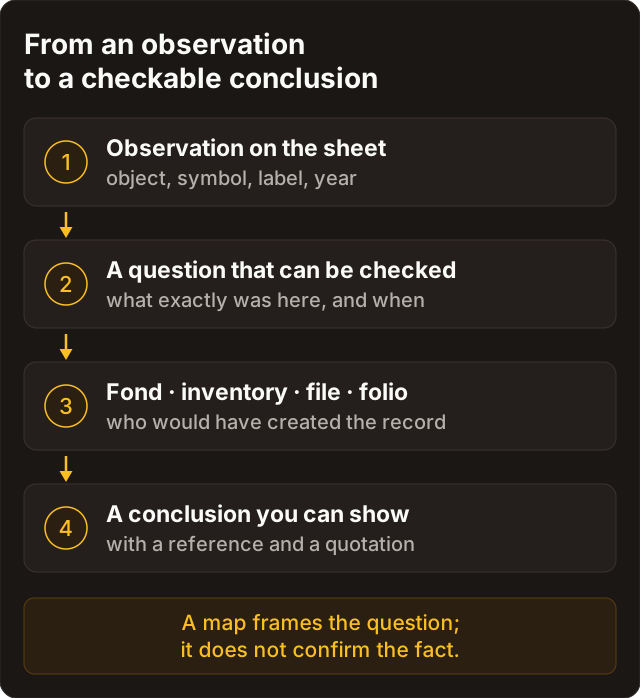
Turning the observation into an archival question
“What was here?” is too broad and almost unanswerable: an archive does not store answers, it stores documents that somebody once created for an administrative reason. So the question has to be rebuilt around records produced by a specific owner, agency or local authority.
| Observation on the map | Likely creator of records | Precise question |
|---|---|---|
| Pond and dam | Landowner, estate management, engineering or local self-government body, local administration | “Do you hold plans, registers or correspondence concerning the dam, pond or mill near Novaya Sloboda for 1890–1925?” |
| Realigned road | Roads or local self-government body, local administration | “Are there road plans, records of a relocated crossing or of bridge repairs near Novaya Sloboda?” |
| Feature missing between editions | Landholding organisation, local executive body, economic enterprise | “Are there acts of demolition, reconstruction, drainage or transfer of the feature for the years in question?” |
| Modern low ground and linear vegetation | Land drainage or hydraulic engineering organisation, project archive | “Do you hold material on drainage, ditches or regulation of the stream in this locality?” |
The question must not argue for your version. The phrasing “dam, pond or mill” keeps it open: the archive may confirm a different kind of feature, or point to a different fond — and that is a normal result, not a failure.
The sample letter
The addressee in the case is chosen by the same logic as above: territory and type of record, not the most famous institution. For local plans, registers and correspondence the regional archive is checked first, and before writing you look into the catalogue of guides to the federal archives of Russia and the Belarusian fond catalogue, so that the letter can name a probable fond or at least a direction.
Subject: thematic enquiry — pond, dam and possible mill near Novaya Sloboda, 1890–1925.
Dear colleagues at [name of institution],
I should be grateful to know whether your holdings contain documents relating to a pond, dam, mill or other hydraulic structure near the village of Novaya Sloboda [modern district and region; historical administrative unit if known] for the period 1890–1925.
Purpose of the enquiry: to establish the nature of a feature shown on a topographic map and the chronology of its existence and alteration.
What is already known:
- on the map [series, sheet, year, scale] a pond, a dam and the label
мельн.are shown beside a stream; - on the map [series, sheet, year, scale] the pond is not shown;
- I am interested in plans, registers, correspondence, acts of repair or demolition, and material on drainage or regulation of the watercourse;
- a small sketch is attached, with the map source cited and without publishing sensitive coordinates.
If these documents are not part of your holdings, I should be grateful for any indication of the archive or type of fond where they might be sought. Please also advise on the procedure and cost of digital copies if material is available.
Yours sincerely, [name, e-mail].
The letter contains no assumptions about the war, destruction, “treasure”, archaeology or a right of access. It describes an observation and asks for specific record types — which is a letter a member of staff can actually answer.
Three possible replies and what to do next
Scenario A. The archive found the exact file.
Suppose the reply reads: “File identified: fond N, inventory N, file N — ‘Correspondence on the repair of the dam at the mill of the village of Novaya Sloboda’, 1911.”
| What is now known | What is still unknown |
|---|---|
| In 1911 a mill and a dam existed and were the subject of correspondence | The construction date, the exact structure, what happened after 1911 |
| The file relates to the right territory and the right feature | Whether the feature still stood at the date of the later sheet |
| There is a reference code for ordering copies or a reading-room visit | How much of the information is actually on the folios of the file |
The next step is to order copies or read the file in the reading room, then cite it precisely: fond, inventory, file, folio and the literal wording of the relevant passage. A summary from memory a month later turns straight back into the legend we were trying to leave behind.
Scenario B. The archive gives a direction, not a document.
The reply: “No information identified in our holdings; we suggest checking the fond of the local self-government board, the archive of the neighbouring region, or the archive of technical documentation.”
This is not a failure. The archive has done something valuable — it has narrowed the route. The notebook records not “nothing exists”, but “institution X identified nothing along the stated line; fond or archive Y recommended”. The next letter is adapted to the new addressee and states the checks already made, so staff are not sent round the same circle.
Scenario C. A different feature is confirmed.
The archival record may turn out to concern not a mill but, say, a pond for estate water supply, a water intake, a fish-pond dam or a road repair. That is a good scholarly result: the hypothesis has been corrected by a document rather than bent to fit one.
| Old hypothesis | Documentary result | New conclusion |
|---|---|---|
| “Probably a mill” | The file names a pond for water supply | The map shows a hydraulic structure; a milling function is not confirmed |
| “The bridge went in the war” | The plan records a road realignment in the 1930s | The change belongs to road reconstruction; the reason the old symbol vanished is now clearer |
| “The old channel is natural” | The project file names a drainage ditch | The linear feature is artificial in origin |
Turning a document into a conclusion
An archival document is not a magic seal over the whole story. It confirms only what can honestly be drawn from its text, date, authorship and context. After that the work is editorial: writing your own sentence without letting it outgrow the source.
| Wording | Assessment |
|---|---|
| “A file of 1911 mentions repair of the dam at the mill of the village of Novaya Sloboda” | Correct, if that genuinely follows from the text of the file |
| “A mill existed no later than 1911” | A permissible inference from a documentary mention |
| “The mill was built in 1911” | Not permissible if the document speaks only of repair |
| “It disappeared after the war” | Not permissible without a source for the date and the cause |
| “Map and file agree: the sheet shows the feature and the file confirms it was working in 1911” | A correct synthesis of two sources with the limits stated |
The best outcome of this case reads like this: the topographic sheet shows a pond, a dam and the label “мельн.”; a file of 1911 confirms repair of a dam at a mill in this locality; the construction date and the later fate of the feature require separate sources.
Such a conclusion is no less interesting than the legend. It is stronger — because it can be checked, extended and quoted.
A document about the past grants nothing in the present. A feature confirmed by an archive is still a point on somebody else's land and may carry heritage protection: the legal regime is checked separately — see metal detecting and the law, which describes the Russian and Belarusian rules for readers searching there. At any sign of an archaeological layer, a burial or ordnance, work stops on the spot and the information goes through the local official procedure; why this is the amateur's boundary is set out in the test pit and where to stop.
The archival-trail card in Discovera
Discovera links the map to the document as long as the card does not degenerate into an unstructured note. Create a separate record for each source — on the same logic as the find card.
| Field | What to store |
|---|---|
| Research question | “Confirm that a mill existed near … between 1890 and 1910” |
| Source map | Series, sheet number, year, scale, link to the scan |
| Archive, museum or library | Full name of the institution and the official URL of its contacts page |
| Request | Date, subject line, a short version of the text, registration number if issued |
| Answer | Date, who replied, the outcome, the next step they suggested |
| Reference code | Fond, inventory, file, folio; the exact wording of the file title |
| Copy and rights | Link to the file, terms of use, the required form of credit |
| Confidence | Fact, confirmed hypothesis or working hypothesis |
Keep the map’s own wording separate from your interpretation. “The 1906 sheet is labelled mill” is an observation. “A watermill built in 1898 stood here” is a conclusion that needs a document or a solid publication behind it. Merging the two in one field is the fastest way to forget, six months later, what you actually saw and what you inferred.
FAQ
Can I write to several archives at once?
Yes, if the requests genuinely fall under different competences. But do not circulate one generic letter to everybody. For each addressee change the subject line, explain why you are writing to them specifically, and ask only for what they might plausibly hold. A blanket mailing of one text is obvious on sight and usually earns an equally formal reply.
Do I need to state the purpose of my research?
Yes. One honest sentence helps the archivist judge the depth and type of answer to give: a certificate, an extract, a copy or advice on where to look next. Do not inflate the status of the work — “personal local-history research” reads better than a vague “important project” and creates no expectations you cannot meet.
Can I order a copy without visiting?
It depends on the institution and the document. Some archives accept remote orders, others require a form, a personal account, prepayment or work in the reading room. RGIA sets out its copying and independent-research procedure on its official site, and it is worth checking there on the day you write rather than relying on someone else’s summary.
What matters more: the name of the place or the coordinates?
For an archival search, the administrative attachment, the period, the spelling variant and the type of document usually matter more. Coordinates help you align a map with a modern image, but they rarely replace the historical name in a finding aid, and they should not be published if the site is potentially sensitive.
When is it time to write to a museum?
When you need object, collection or research context: an accession entry, a collection, a field report, a photographic record, a publication or a specialist consultation. If you are after plans, correspondence and registers, start with an archive or a library — a museum will not help you there.
The archive is slow to reply. Should I send the letter again?
First check the official deadline and submission procedure published on the institution’s site. If the deadline has passed, send a short polite follow-up through the same channel, quoting the date and subject of your original letter. There is no need to send a fresh long request each time: that simply moves you to the back of the queue.
Do I need to find the exact fond first?
Ideally yes, but it is not required. It is enough to narrow the enquiry to a territory, a period, a record type and a probable creator. An archive can point to a fond or a direction if the question is specific; there is simply nothing to answer to “what have you got on our village”.
The map and the document contradict each other. Which is right?
They may describe different moments, different aspects of the feature, or simply differ in accuracy. Do not pick the convenient source. Build a chronology, compare the survey and printing years of the sheet with the date of the document, and state the contradiction as a separate research question.
Can an archival reply prove that I may access the site today?
No. A documented fact about the past of a feature grants no right of access, work or intervention today. Ownership, heritage status and permits are checked separately and under current rules, not by a date in 1911.
If the archive asks for payment, should I simply decline?
You can ask for an itemised estimate: search, copies, delivery, publication rights. Sometimes it is enough to obtain the reference code and the description first, and order the copy later — or read the file yourself in the reading room.
How should a file be cited?
In full: archive, fond, inventory, file, folio — and separately what you took from it. Shortcuts from memory and a retold summary without a folio number make the citation unverifiable, and therefore useless to anyone who wants to continue the work.
Sources
- Catalogue of guides to Russian federal archives — composition and location of fonds
- GARF — contacts and the procedure for registering requests
- RGIA — requests, copying and reading-room access
- Fond Catalogue of the state archives of the Republic of Belarus
- Archives of Belarus — contact information for the state archives
- NARB — contacts and opening hours
- NIAB — contacts and the channels for different request types
- NIAB in Grodno — contacts and competence
- U.S. Geological Survey — Topographic Mapping