 Google Play
The word "hoard" conjures a chest. In reality it is almost always a complex — several objects hidden together for one specific everyday reason, and that reason can be read from the location.
Knowing the type is useful for practical rather than romantic reasons: different types are hidden in different places, and knowing that saves weeks of walking. Maps are in reading old maps, the legal frame in legal status and regional rules.
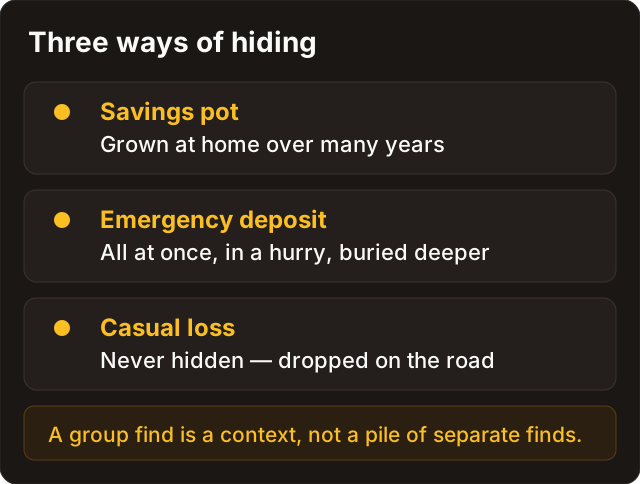
The savings pot
Family savings accumulated over years, and the logic is domestic: the money has to sit somewhere you can add to it at any time.
Hence the location — shallow and within the yard: the corner of the house, the cellar, a distinctive tree in the garden. The contents are usually copper, sometimes with a layer of silver.
On the map, look for the yard, the garden, the living area. Not a lone bush a kilometre from the homestead — nobody walked out there to add a kopek.
The panic hide
Hidden in a hurry and for a bad reason: war, a pogrom, dekulakisation. Hence the character — compact and more valuable: silver, awards, jewellery.
The spot is chosen for speed rather than convenience: a boundary, the edge of woodland by a road, a distinctive stone. The depth is often literally one spade's depth — there was no time.
The context here is a stressed boundary of the plot, not the middle of a field.
Foundation deposits
A good-luck ritual during building: a coin placed under a corner, under the icon corner, or into the foundation itself. One coin or a few, never a bag.
It doesn't get confused with a savings pot: different density, different part of the house.
Reading the place
- Find the yard on the historical layer.
- Compare with satellite: where the building corners, the garden and the boundary survive.
- Mark the polygon before you start the grid.
- In the field work from domestic debris towards a hypothesis, not the other way round: pottery, slag and nails show where people actually lived.
- If signals start adding up to a complex, switch from extraction mode to documentation mode.
If it really is a complex
Here the sequence matters more than the speed:
- Land and heritage status get checked before the spade, not after.
- The whole complex is recorded: how the objects sit relative to each other, depth, and the container if there is one.
- Photographs are taken before you've lifted everything.
- At any sign of an archaeological site or cultural layer — the find procedure, not a social media post.
- The polygon, pins and map layer are saved; the exact coordinates are not published.
The difference between a find and looting is decided at this moment, by whether you preserved the context or distributed it into your pockets in ten minutes.
Four durable myths
"Every hoard is under a lone oak." The lone oak is a landmark from folklore, not from practice.
"Deeper means older." Not reliably: ploughing, slumping and building mix layers as they please.
"I'll lift it and work it out later." There will be nothing left to work out — the scientific and legal context stays in the hole.
"A cross on the map means it's allowed." A map is information, not a permission.
Checklist
- A hypothesis about the type is recorded: savings, panic, foundation.
- The yard or boundary context on the map is clear.
- The complex is photographed before it's taken apart.
- Legal status checked.
- No public coordinates in the diary.
External references
Complexes with archaeological context need care and recording. As a model of recording culture, PAS is worth looking at. The law of your region comes separately, and first.
FAQ
Savings pot vs panic hide?
A savings pot is money in the yard or garden, often copper, kept where it can be added to. A panic hide is haste at a boundary or road, more compact and more valuable. The signs of each are described above.
Where do I find the "psychology of place" on a map?
The corner of a house, the garden, a boundary, a former road. Not the lone oak of legend. Overlay: maps on your phone.
What if the signals add up to a complex?
Stop extracting, take photos and a sketch, follow the legal step. Don't distribute it into pockets. See the procedure.
Can I publish a hoard location?
For valuable or contested complexes, no. That's what the diary is for: it's private.
Is it legal "if I found it myself"?
The law of your region decides, not a sense of fairness. Legal status, regions.