 Google Play
One thing needs saying about AI in metal detecting straight away: it does not work as a treasure radar and never will. No model sees through soil — and anyone promising otherwise has told you quite a lot about themselves already.
What it does handle well is a different job — helping you work out what you've already dug up, and letting you look at treatment options while risking nothing. Below are three situations where that genuinely saves time or saves a find.
Related: restoration principles, copper and bronze, beginner mistakes.
"What even is this"
The classic situation: a worn mount comes back from the field, you can't identify it by eye, and within a week it's lost among two hundred other photos in your gallery.
The sequence is simple:
- Create the find in the catalogue and pin the spot on the map.
- Upload "as found" photos — several angles, daylight, no glare.
- Run the analysis and get hypotheses, plus pointers on what to compare against next.
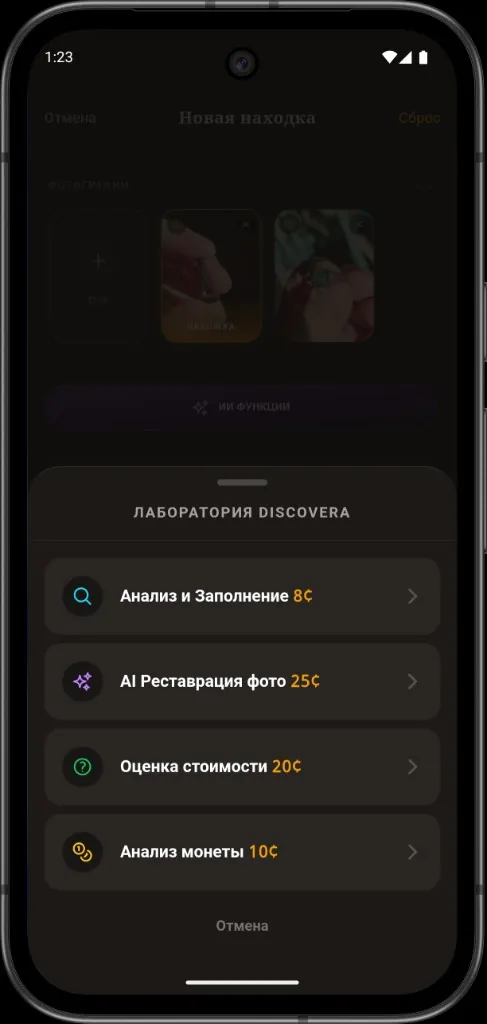
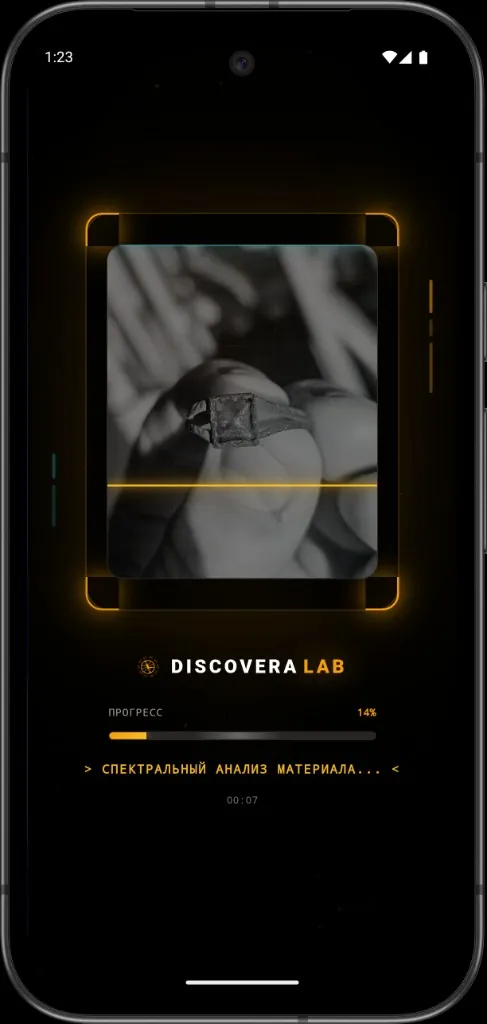
The result isn't a verdict, it's a narrowing: button, coin, or a fragment of something larger. From there you compare against a catalogue yourself. The cost in coins is shown before you start, so there are no surprises.
Restoration on pixels first
The second scenario is the most useful one. You've found a ring, it's dark and unpromising, and your hand is reaching for the cleaning kit.
Run the photo through AI restoration before you touch any chemistry. You'll see a version of how it might have looked and can decide calmly whether the original is worth touching at all. Often it turns out it isn't.
And if it is, then by the guide for that specific metal, with consolidation at the end. The point is that the experiment happens on a file, while the "before" reference stays in the diary permanently.
Context beats a nice photo
A beautiful shot of a find with no pin and no map layer means nothing in a month. In a year, less than nothing.
So the card is worth filling out properly: coordinates, the historical map layer, the pre-cleaning photo, and a note about the tone and VDI (see VDI and discrimination). Then the AI works from the best possible input, and you're left with a reproducible archive of the outing rather than a set of pictures.
Where the line runs
| AI helps with | AI doesn't replace |
|---|---|
| A hypothesis about the object type | Lab analysis and metal testing |
| A visual "what if I cleaned it" | A safe chemical protocol |
| Cataloguing and comparing finds | A permit, or knowing the law |
| A first draft of the diary description | Ethics: exact coordinates of valuable finds stay private |
The right column matters more than the left. A model can be confidently wrong, and on a rare object the price of that is the object.
The mentor chat
The in-app mentor answers practical questions about machines and scenarios in plain language, without forum snobbery. It's learning support rather than an instruction on where to dig — and it says so honestly. For hardware, see also choosing a detector.
Checklist
- Photos in daylight, without heavy glare.
- The pin and the "as found" shot saved before the analysis.
- The cost read in advance.
- The original stays uncleaned until the preview has been considered.
- The result is treated as a hypothesis. Always.