
 Google Play
Imperial copper and silver are the commonest meaningful find on ploughed land and around old homesteads. The catch is that in the field they usually look like a green disc of indeterminate denomination, and working out what you're holding takes a while.
This is an educational overview, not a price list or a rarity catalogue. And before going further: make sure it's a coin at all rather than a button or a token — that's visual identification. The context of the yard is read from old maps.
What actually turns up
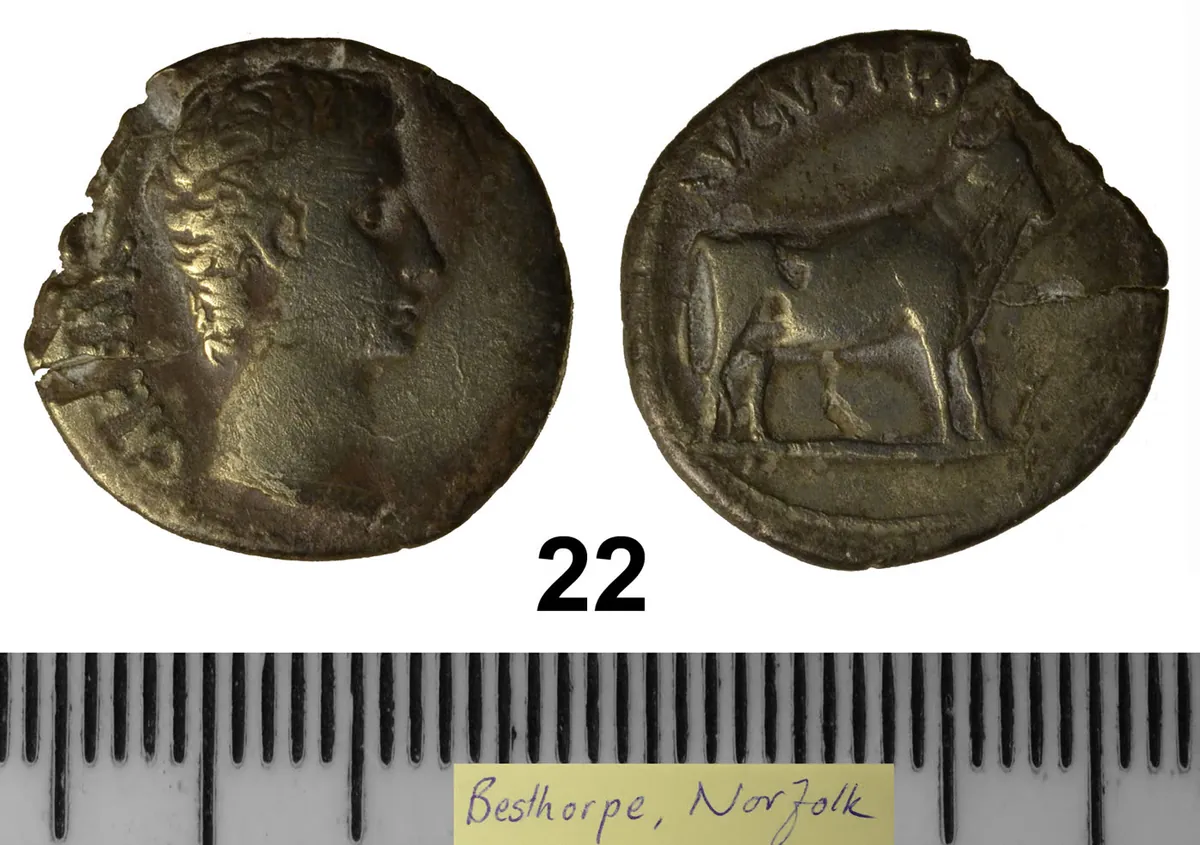
| Class | Where it turns up | How it looks in the field |
|---|---|---|
| Copper: denga, kopek, 2–5 kopeks | Homestead, fair, highway | Green or brown patina, edges eaten away |
| Small silver | Yard, boundary, road | Dark sulfide, sometimes a blank "wafer" |
| Later 19th–20th c. denominations | Same zones plus later layers | Date and mint read noticeably better |
Don't chase the big Catherine five-kopek piece exclusively: everybody is looking for it, and it usually turns up for the people who weren't. Mass copper from the Alexanders and Nicholases turns up far more often and gives you statistics for the site — and statistics eventually lead to the better finds.
Rulers' ciphers
| Ruler | What shows on copper |
|---|---|
| Peter I | Interlaced Latin P |
| Catherine II | Е II; large, heavy five-kopek pieces |
| Paul I | A plain Cyrillic П |
| The Alexanders | А with a numeral |
| Nicholas II | Н II |
The cipher alone settles nothing. Attribution needs the set: date, mint, denomination and the state of the relief.
Mint letters
- Е.М. — Yekaterinburg, the main source of mass copper.
- С.П.Б. and С.П.М. — Saint Petersburg.
- К.М. — Kolyvan, Siberian copper.
- М.М. — Moscow, В.М. — Warsaw, where applicable to the type.
Mint letters often only read under raking light and a loupe — which is exactly why you photograph before cleaning, not after. What you rub off won't be readable later.
What to log
- Size and thickness, ideally with a ruler in frame.
- Denomination, arms, cipher — what's visible and what isn't.
- The edge, if it survives. Don't file it down for tidiness.
- Holes and suspension wear: the coin may well have had a second life as jewellery or a home-made button.
Why reforms matter in the field
Knowing roughly which era a striking belongs to saves you confusing visually similar discs. The Kankrin reform of 1839–1843 and the later silver types are well covered in the literature — but attribute from a catalogue, not from somebody's memory in a group chat.
If the type doesn't add up, it is more honest to log "unsure" with a macro shot than to record a wrong attribution that will look like a fact a year from now.
Cleaning stop-rules
- Copper: first understand patina and bronze disease. Cleaning down to pink metal is never the answer.
- Silver: sulfide and thiourea, and leave rarities alone.
- Doubtful type: an AI preview on the photograph first, and only then a decision about chemistry.
The typical situation
A five-kopek piece comes back from the field, the date won't read, and your hand reaches for a knife. The correct sequence is: macro shot under raking light, mint hypothesis written into the card, gentle soap per the copper guide, then a second photo. Knives and sandpaper play no part in this scenario at all.
Attribution checklist
- Photographed before cleaning.
- Mint and date recorded — or honestly marked unreadable.
- A scale in frame.
- The context preserved: homestead, highway, fairground?
- Any suspicion of rarity means cleaning waits.
External references
Check types against catalogues. As a model of find-documentation culture, PAS is worth looking at. A price quoted in a chat is not a source.