
Conversations about gear almost always collapse into which control box to buy. Meanwhile the difference between a good outing and a bad one is more often decided by whether you brought a pinpointer, and whether your spade suits the ground.
A flagship without a pinpointer loses to a budget machine with one — not on depth, but on finds per day. Here is what a working kit actually consists of.
Machines by tier
| Tier | What you're paying for | Where to look |
|---|---|---|
| Entry | Simplicity and weather sealing | Simplex Ultra, X-Terra Pro |
| Mid | Multifrequency without the premium | Nokta Legend |
| Flagship | Separation speed, salt, heavy trash | Manticore, Deus II |
Buying "to grow into" on credit before you have 10–15 outings behind you is a bad idea for a simple reason: you don't know your scenario yet, so you're buying for somebody else's. Model breakdown in choosing a detector.
What's mandatory besides the box
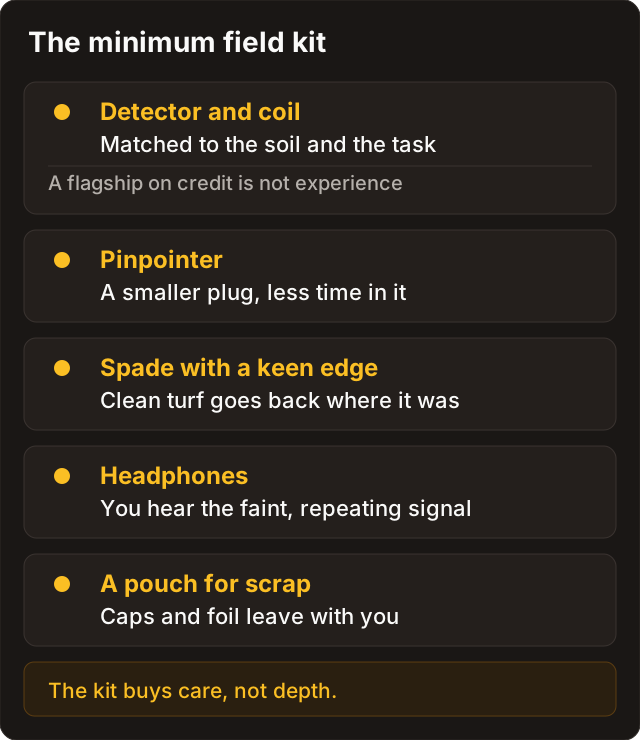
- A pinpointer. More important than a second coil early on, by a wide margin.
- A spade or T-handle suited to your ground. Woodland and beach are different tools.
- Headphones. Less ambient noise, better tone, and a faster grip on the sound-to-target link.
- Control box protection and a coil cover, plus spare power.
- A finds pouch, gloves, water, a phone that works. The boring part of the list that keeps an outing an outing rather than an adventure. Adventures in this hobby happen exclusively to people who skipped it.
Coils can wait
Changing a coil makes sense once you understand your scenario: a sniper coil among roots in woodland, a wide one on open field. Before that the stock coil will serve you better, if only because you'll have time to get used to it.
What's more useful in that period isn't buying more hardware but keeping statistics: which mode and which coil actually produced finds.
Packing
- Machine assembled and tested at home, not on a verge in the rain.
- Pinpointer and spade didn't stay in the hallway. This happens more often than anyone admits.
- Offline map and polygon downloaded in advance.
- Power bank and a spare cable.
- First aid kit, and an agreed rule about unexploded ordnance — see the safety guide.
Worth logging
Note the machine, coil and mode next to your finds. After a season it becomes clear what works on your ground rather than in a review video. That is also the answer to when to upgrade: when the diary shows what you're actually running into.
Five common misses
- Flagship present, pinpointer absent.
- One spade for every kind of ground.
- No box protection — until the first downpour.
- Headphones "later".
- No record of which mode produced what.
Buying checklist
- Scenario is clear: woods, field or beach.
- A pinpointer is in the budget of the first purchase.
- Service and firmware are available in your region.
- There's a plan for learning the settings.
- There's somewhere to log outing statistics.
FAQ
Which detector should a beginner buy?
The one that covers your scenario and leaves room in the budget for a pinpointer. A flagship on credit "to grow into" — no. Reference points in choosing a detector.
Pinpointer or second coil first?
Pinpointer, no contest. You change a coil once the scenario is clear and you have signal statistics.
Are headphones required?
Yes. Less noise, more audible half-tones, and a much faster habit of reading a target by ear rather than by number alone. See VDI.
When to upgrade the machine?
After 10–15 logged outings. By then it's visible whether you're limited by iron, by salt or by depth — and the upgrade becomes a decision rather than an advert.
Where to compare specs?
In the app catalogue and in choosing a detector. Log the mode and coil next to your finds and you build your own comparison base.
Coil cover and control-box protection?
Yes, especially in woodland and rain. A cover costs a small fraction of a replacement coil. See also safety.