
This is a reference, not an invitation to pour acid on everything. The point is to understand what each product actually does — once you do, it becomes obvious why conservators work at the lowest concentration that solves the problem rather than the highest one that solves it fastest.
The general framing is in principles; the specific protocols are per metal: copper, silver, iron.
The kit that's hard to do damage with
This is where you start, and where about eighty percent of field finds also finish.
| Product | What it does |
|---|---|
| 72% laundry soap | Softens soil and loose oxides, leaves dense patina alone |
| Distilled water | Rinses and solutions. Tap water brings its own salts |
| Soft brushes | Mechanics without scratches |
| Loupe and good light | Let you see what you're doing before you've done it |
| Gloves, ventilation | Boring, right up until the day it isn't |
Distilled water is not pedantry here. The whole point of rinsing is to get salts out of the pores; rinse with water that contains salts and you are simply swapping one set for another.
Chemistry does not identify the material
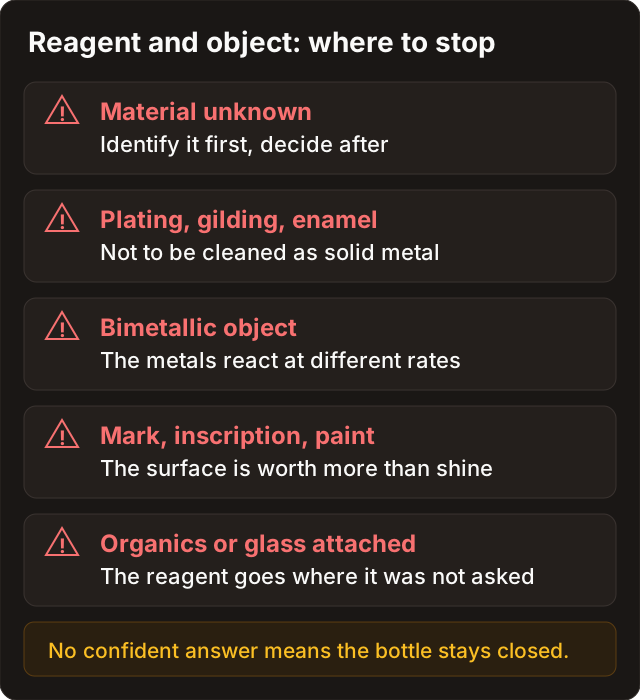
A chemical test on the object itself is not a safe way to learn what it is made of. The reagent changes the surface, and without a comparison sample and proper analysis the result reads badly: a stain appeared — and what exactly did it prove? So what follows explains what these materials are for and what they risk, rather than telling you to put a drop on it and see.
| Situation | Limit |
|---|---|
| Material unknown | Reagents, acids, alkalis, solvents and electrolysis are not used as a test |
| Plating, gilding, silvering, niello, enamel, glass | The generic metal protocol does not apply |
| Bimetallic pieces, or metal with organics | Any liquid or chemical treatment has to be compatible with every material at once |
| Inscription, hallmark, painted decoration, lacquer | The surface is not opened up for legibility before photographs and assessment |
| Old coating of unknown composition | Nothing new goes on top without a record and a compatibility check |
If the material is not identified, the route leads back rather than to a reagent: the first 24 hours after a find, then restoration principles and water, salts and hydrolysis. A stop signal is a reason to move to special cases, not to the next method.
The more interesting reagents
- Citric acid (~10%) — silver oxides. Works fast, and goes matte just as fast.
- Sodium sesquicarbonate (~5%) — against bronze disease. Baking soda is weaker and often can't cope with active spots.
- Thiourea — sulfide blackening on silver. Follow the instructions, and not on your first coin.
- Washing soda — the electrolyte for iron electrolysis.
- Ammonia and strong acids — high risk, and impossible to dose by eye. Copper comes out of them pink and soft.
The limits for each metal are in the dedicated guides and the checklist.
Mechanical tools
A fiberglass brush only works wet and without pressure: dry, it leaves a matte web that shows up at every angle afterwards. Scalpels and needles are for spot work on thick crust, not for running over silver "to brighten it". Ultrasonic baths are acceptable with one metal at a time, distilled water and a timer. For recesses, nothing beats toothpicks and wooden sticks — wood is softer than any metal you'll be working on, which makes it safe by definition.
The order that saves finds
- "Before" photo.
- Soap and mechanics.
- Only if needed — a narrow reagent for that specific metal.
- Generous distilled rinse.
- Drying and consolidation.
Note that chemistry is third, not first. That isn't caution for its own sake: most finds never get that far.
Fumes ruin the neighbours
A reagent damages more than what you put in it. An open container on the bench works by area. The fumes reach the coins on the shelf opposite quite happily, and you will then spend a long time wondering why a piece you never touched went dark. Close your containers and move the collection out of the work area.
Consumables and waste
Anything that has been in contact with the object or with the chemistry counts as contaminated: solutions, cloths, brushes, gloves, filters. Solutions carrying salts, metals or reagents do not go down the drain and do not sit in unlabelled jars — in a month nobody remembers what is in that one.
- Label the container as you fill it: contents, concentration, date.
- Collect spent solutions separately and dispose of them under your local hazardous waste rules.
- Keep only the volume of reagents you genuinely need: a just-in-case stock is a storage risk and nothing else.
- Rinse water from a desalination soak does not go back into use. The salts it pulled out are still in it.
Working with reagents means gloves, eye protection and ventilation, not one quick minute with the window shut. Keep containers closed and labelled, and keep the work area away from the collection and away from food.
Worth remembering
- Patina and disease are different things, and confusing them is expensive.
- Bright powder and growing spots mean stop, and switch to the soft copper protocol.
- Salts and pH matter more than the strength of the acid.
- After any active phase: rinse and consolidate.
- Write down what you used and how long it sat. In a year that note will be the only source of truth.
External orientation
Recipes from forums are worth checking against proper sources: the metals section at Canadian Conservation Institute explains exactly this logic of the minimum sufficient concentration.